
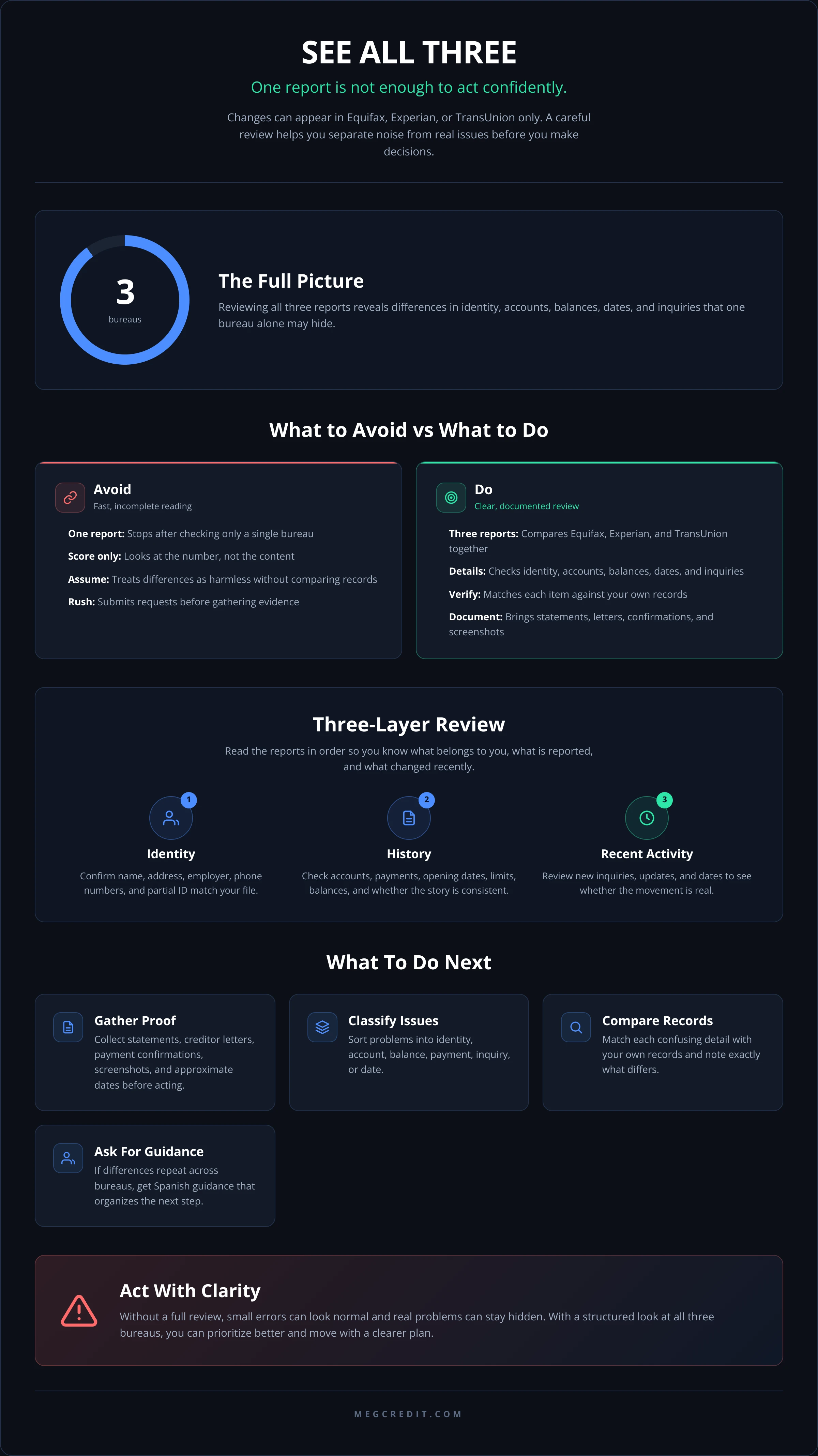
- Review all three reports, not just one: important changes can show up at one bureau and not the others.
- Look for personal data, accounts, balances, dates, and inquiries; that is where the discrepancies that affect you most often hide.
- A well-read report helps you decide what to fix first and what documentation to gather before you act.
- If you find confusing information, compare each detail with your records and do not assume it will “just work itself out.”
- Guidance in Spanish can save you time and keep you from taking steps that make your credit history more complicated.
Reviewing Equifax, Experian, and TransUnion Without Losing the Thread
There is a very common scene: someone opens a credit report, sees several pages of numbers and abbreviations, and closes the screen two minutes later. A day later, they try again, this time in a rush because they need to make an important decision. At that moment, review Equifax Experian and TransUnion stops being a technical task and becomes a way to organize a real problem.
If you live in Orlando and work, pay bills, make budget adjustments, and still feel like your credit changes without warning, you are not alone. The hard part is not just looking at the three reports; it is understanding what matters most, what is duplicated, and what needs immediate attention. That is where a serious review makes the difference.
What You Should Check from the Very First Minute
Start with the basic information: name, address, previous employer, phone numbers, and partial ID number. An error here does not always lower your score, but it can indicate that the file is not properly matched or that information is mixed with someone else’s.
Then look at open and closed accounts, reported payments, opening dates, limits, and balances. When someone tries to review Equifax Experian and TransUnion, they often find that the same account appears with slight variations across bureaus. That difference may be normal; it may also be a sign of incomplete or outdated reporting.
How to review Equifax Experian and TransUnion Clearly
A useful read does not consist of memorizing every line. It consists of separating noise from what could affect your next financial decision. If you are about to apply for a credit card, rent, or financing, it matters to know whether your profile looks stable, whether old accounts are being reflected incorrectly, or whether any recent inquiry needs explanation.
A practical method is to review the report in three layers: identity, history, and recent activity. First you confirm the data belongs to you. Then you verify whether the accounts tell the right story. Finally, you look at what moved in the last few months and whether that matches your real activity.
Normal Differences Between Bureaus and Signs You Should Not Ignore
Not every difference means there is an error. A creditor may report to one bureau before another, or a balance may update on different dates. What does deserve attention is a nonexistent account, a payment marked late when you have proof, a limit that disappears for no reason, or an inquiry you do not recognize.
If an account looks fine in one report and strange in the other two, do not write it off or assume it is already fixed. Compare the age, partial account number, status, and last update date. That kind of orderly reading avoids unnecessary arguments and helps you communicate more precisely.
What Documents It Is Worth Having Ready
Before you change anything, gather statements, creditor letters, payment confirmations, and screenshots of your records. If there was an address change, move, or closed account, it also helps to have approximate dates. Anyone who wants to review Equifax Experian and TransUnion seriously needs evidence, not just intuition.
If you want to prepare better for that process, this guide to getting ready for a credit review may help. It does not replace a full review, but it does help you arrive with the right material and less improvisation.
Common Mistakes That Cloud the Diagnosis
One of the most common mistakes is focusing only on the score and not the content of the report. The number summarizes, but it does not explain. Two people can have similar scores and completely different issues: one due to high credit utilization, another due to an account with incomplete history, another due to recent inquiries.
Another mistake is assuming any old account “doesn’t matter anymore.” Age, account type, and payment pattern can still have an effect even if the account is inactive. It is also not wise to focus only on removing something; sometimes the real issue is how it is being reported, not the existence of the account itself.
Signs That Often Go Unnoticed
There are small details that change the picture quite a bit. An inconsistent opening date can alter the average age of accounts. A balance that looks high because the last payment was not reported can give you the wrong impression of your utilization. A duplicated account can make it seem like you owe more than you really do.
When you review Equifax Experian and TransUnion, think like someone comparing versions of the same event. If the three reports tell similar stories, you have a stronger basis for deciding. If one of them is off, do not ignore it for convenience.
What Usually Makes Things Worse If You Act Without a Plan
Submitting requests without reviewing the documentation usually creates more friction. The same happens when valid disputes are mixed with claims that have no support. If a detail is correct but you do not like it, that does not make it an error; if it is wrong, you need arguments, not just frustration.
It is also wise to avoid impulsive decisions like opening new accounts to “make up for” a negative item. Sometimes that adds inquiries, lowers age, or makes the overall picture harder to read. A responsible strategy puts order before speed.
What to Do After You Find Inconsistencies
When you notice something off, the first step is not to panic. The first step is to classify it: identity, account, balance, payment, inquiry, or date. That classification helps you decide whether you need documentation, a creditor explanation, or a broader review of the reports.
If the data seems incorrect, compare the report with your own records. If it does not match, note exactly which part is wrong and when you first noticed it. If it only partially matches, do not settle for the most convenient version; review the full context before moving a piece.
How to Prioritize Without Getting Overwhelmed
Not everything gets fixed at the same time, and not everything deserves the same urgency. A misclassified account may need attention before a minor inquiry. An outdated address may be less critical than a payment reported incorrectly. Prioritizing keeps you from wasting energy on details that do not change the big picture much.
For anyone who does not want to move forward blindly, a clear read of the credit report is often the best starting point. Understanding the structure makes the review of Equifax, Experian, and TransUnion more useful and less exhausting.
When It Is Worth Asking for Guidance
If you find several discrepancies, if an account appears strangely in more than one bureau, or if you do not feel comfortable telling the difference between errors and normal variations, asking for guidance can save you from poorly aimed attempts. In Orlando, many people prefer an explanation in Spanish because it lets them ask specific questions without losing details.
Magic Enterprise Group works exactly at that point: review of the three reports, identification of opportunities and inconsistencies, and educational guidance so the person can decide more clearly. It is not about promising automatic results; it is about reading what is already there well and building a reasonable plan.
Financial Education and Habits That Support Your Profile
A report can look “clean” and still be fragile if financial behavior remains disorganized. Credit does not improve by magic, and it does not hold up on the strength of a single correction. You need to understand how the factors around the history move: on-time payments, utilization, age, mix of accounts, and inquiries.
The content about the factors that influence your credit score helps put the bigger picture into context. Knowing what matters most and what matters less keeps you from giving too much weight to a secondary detail or too little to an important signal.
Habits That Truly Help
Paying on time remains the foundation, but that is not enough if the rest of the profile is out of order. Reviewing statements, avoiding maxed-out limits, and keeping proof of your payments make it easier to defend your history when something does not match. It also helps not to open accounts on impulse when you still do not understand how they fit into your profile.
If you use digital tools to track progress, it can also be useful to complement them with personal organization resources like iam-eva.ai when you need to organize tasks and follow-up. It does not replace a credit review, but some people appreciate any support that reduces operational chaos.
A Realistic Plan Shows Up in Small Changes
Anyone who tries to review Equifax Experian and TransUnion with a medium-term view usually benefits more than someone who is only chasing a single correction. A personalized plan may include periodic review, priority setting, document tracking, and monitoring of reported changes.
That approach also teaches you to read the consequences better: when it makes sense to wait, when it makes sense to act, and when you need to clarify a point with the creditor or the bureau. That calm is not passivity; it is strategy.
How to Handle It If You Need Support in Orlando
Many people arrive with a mental list of problems but do not know where to begin. Others have already compared their reports and only need confirmation of what matters and what does not. In both cases, what helps is guidance that does not replace your judgment, but organizes it.
At MAGICENTERPRISE GROUP, the focus is on three-bureau credit evaluation, Equifax, Experian, and TransUnion analysis, and a personalized credit improvement plan designed for the Spanish-speaking community in Orlando. The idea is to help you understand the report, identify opportunities, and support follow-up without selling shortcuts or unrealistic promises.
What You Can Expect from a Well-Done Review
A useful review should tell you what appears, what does not match, what deserves explanation, and what actions make sense for your case. It should also leave you with a clear roadmap, not more confusion. If something cannot be resolved right away, at least it should be clear why and what comes next.
If you still do not know how to organize your documents or what to bring to the appointment, review this credit review preparation. Arriving organized changes the quality of the guidance quite a bit.
How an Educational Guide Differs from an Empty Promise
A responsible guide does not promise a guaranteed score increase, because that depends on many factors outside anyone’s control. It also does not sell the idea that everything gets fixed with one move. The serious approach is to identify the current state, explain what is affecting the profile, and decide on a work plan with clear judgment.
If you would rather speak with someone who can review your case with you and explain the three reports in Spanish, you can visit the Services page or learn more about us before taking the next step.
Frequently Asked Questions About Reviewing the Three Bureaus
Is it worth reviewing all three reports at the same time?
Yes. Reviewing only one can leave out important differences that do appear at another bureau. If you are going to make a credit decision, looking at all three reports gives you a fuller picture.
What should I do if one report has an account that the other two do not show?
First confirm that the account really belongs to you and compare it with your records. Then review dates, balances, creditor name, and account status to see whether it is a different update or an inconsistent piece of data.
Does an error in the report always lower the score?
Not necessarily, but it can still affect the overall reading of your history. An error can alter age, balance, utilization, or the appearance of risk, even if the exact effect depends on the type of data.
Can I review Equifax Experian and TransUnion on my own?
Yes, and in fact it is a good idea to know your own reports. Even so, if you find several inconsistencies or do not know how to interpret them, guided review can help you avoid poorly aimed steps.
How often should I look at my reports?
It depends on your situation, but reviewing them regularly helps you catch changes on time. If you are working on your credit profile, it is better to have a more organized follow-up than an occasional check.
Does Magic Enterprise Group guarantee results?
No. The guidance is educational and responsible, focused on analysis, strategy, and follow-up. The goal is to help you understand your credit situation and act with better information, not to promise automatic results.
If you have already reviewed your reports and something does not add up, schedule an evaluation through Contact. A clear analysis of your three bureaus can save you unnecessary steps and give you a safer path forward from Orlando.