
Start with what you can actually recognize
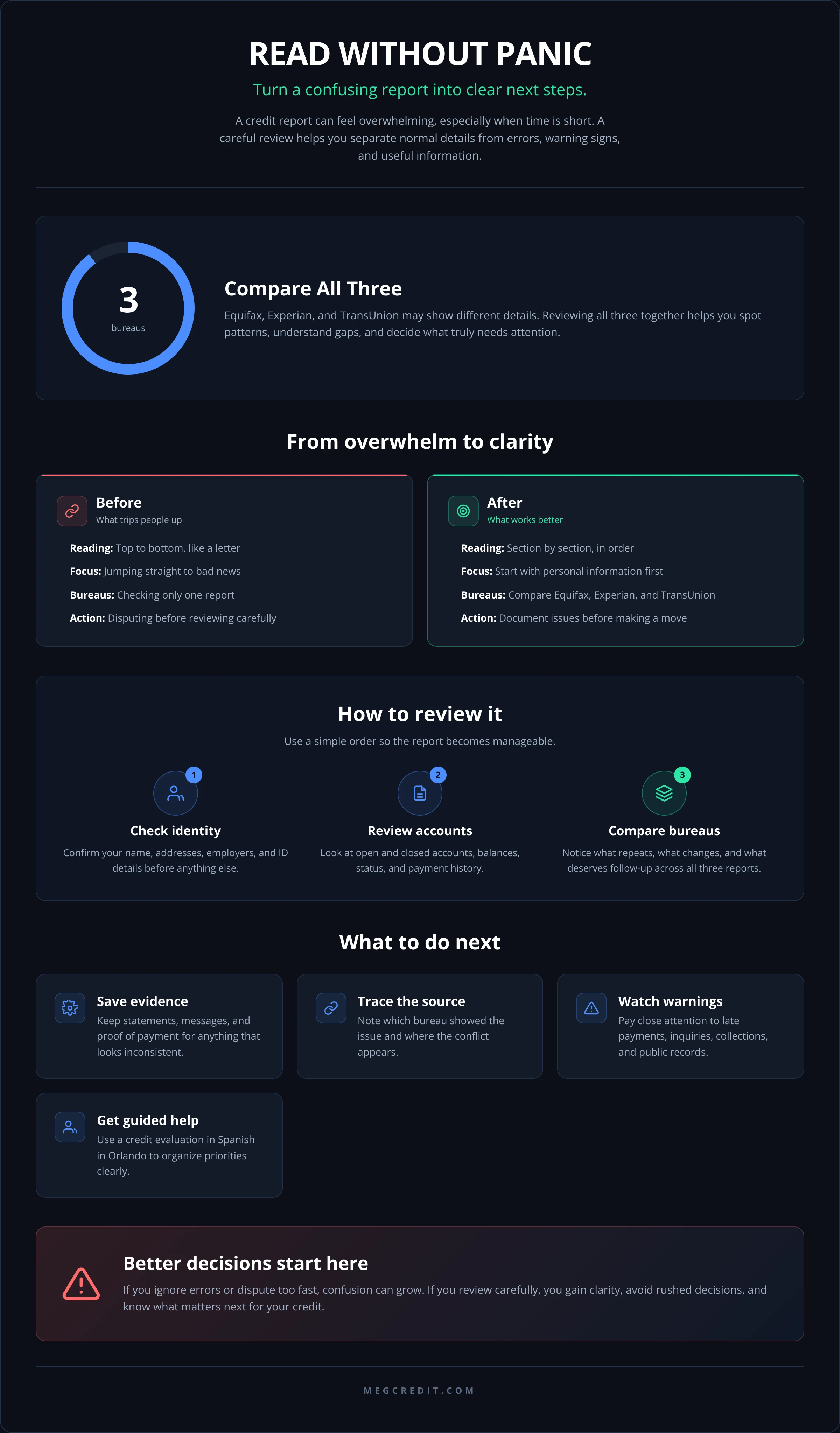
Before diving into accounts, balances, or inquiries, it helps to look at personal information. There you will find your name, addresses, previous employers, partial ID numbers, and sometimes different versions of the same detail. A misspelled last name, an address you never used, or an alias that is not yours is not always serious on its own, but it can indicate that the report deserves a closer look.
Many people get frustrated because they go straight for “the bad stuff” and miss the first thing that should line up. If the report is mixing identities, everything else may need context. That is why a careful credit review that is done right starts with the basics: confirming that the report is really about you and not an incomplete or messy version of your information.
After that initial review, the next step is to identify which bureau issued each report. The three do not read the same, and they do not always show exactly the same information. To understand why that happens, the Federal Trade Commission’s official information on credit reports is a useful, reliable reference.
How to read your credit report without feeling overwhelmed
A report usually looks more complicated than it really is. In most cases, you can read it in this order: personal information, open accounts, payment history, credit inquiries, public records, and remarks. If you move through it this way, you stop seeing one intimidating block and start seeing separate pieces with a purpose.
In a guided credit review, the most useful goal is not to “understand everything” in a single read-through, but to know where to look based on the question you have. If you are worried about a recent drop, check payments and inquiries. If you are worried about an account you do not recognize, go straight to the accounts section. If you suspect an identity error, go back to personal data and addresses.
Personal information and signs of mixed-up identity
Here you are looking for consistency. Your name should be spelled correctly, your addresses should make sense with your history, and your identification numbers should belong to you. An account with an odd name variation may be a clue that an update was not completed, but it could also be a more serious issue if the rest of the report shows inconsistencies.
If you see addresses in states where you never lived, previous names you do not recognize, or employers that do not belong in your history, do not brush it off. Those signs do not always change your score by themselves, but they can make the whole file harder to read. When that happens, a professional credit review helps separate administrative issues from what is truly concerning.
Open and closed accounts: what really matters
Accounts are the heart of the report. That section shows who is reporting the information, the type of credit, the opening date, the limit or balance, the account status, and the payment history. What matters is not only how many accounts you have, but how they behaved over time.
An account may be closed and still appear correctly, or it may show as open even though you already closed it. It may have a correct balance or one that does not match your records. It may show a late payment that happened because of a real oversight, or an overdue payment that you never recognize. In each case, the reading changes, and that is why a credit review service should review each account with judgment, not in a hurry.
Three reports, three perspectives: Equifax, Experian, and TransUnion
Looking at only one report leaves gaps. The three bureaus may contain similar information, but not necessarily identical information. An account may appear on one and not another. A late payment may show up in two and be missing in the third. There may also be differences in how the creditor name, dates, or account status are written.
When you do a complete review, what you are looking for is not perfect uniformity; you are trying to understand why the differences exist and whether they have a reasonable explanation. That is where human guidance makes a difference, because a Spanish-language credit review compares patterns, not just isolated lines.
You do not need to memorize each bureau’s layout to make use of what they show. You only need to notice what repeats, what changes, and what should not be there. If you want to go deeper into how an organized review helps you make clearer decisions, you can read How to Prepare for a Credit Evaluation.
Normal differences and differences that deserve attention
Some differences are common. A creditor may report to each bureau on different dates, or an account may update in one first and then the others. The level of detail in the history can also vary. That does not automatically mean there is an error.
What does deserve attention is an account that does not exist, a late payment that does not belong to you, a balance that changes without a visible explanation, or a duplicate account. When the difference affects a real decision —for example, if you are about to apply for housing or are organizing your finances—, a thorough credit review helps you tell the normal apart from what needs follow-up.
What you gain by reviewing the three bureaus at the same time
Seeing all three reports together helps you spot patterns. If an error appears on all three, the problem is probably at the source of the information. If it appears on only one, the path may be different. That comparison also helps you prioritize: not everything gets fixed at the same time or with the same level of urgency.
A full review is especially useful when someone has changed addresses, has had several accounts, or does not check credit often. In those cases, Magic Enterprise Group works precisely from that complete view: review, organize, and explain without overwhelming you, so you can understand what you are seeing and why it matters.
Warning signs you should not ignore
Some sections tend to draw the most attention because they can affect your situation right away. Late payments, collections accounts, recent inquiries, and certain public records need careful reading. They do not all mean the same thing, but all of them deserve a calm review.
A recent overdue account does not always carry the same weight as an old one, and a legitimate credit inquiry is not the same as an access you do not recognize. In a guided review, the goal is to understand the context before deciding whether to dispute, document, or simply monitor.
Late payments and their real context
Payment history is often one of the most sensitive sections. It shows whether you paid on time, fell behind, entered special arrangements, or had accounts closed for mismanagement. One late payment does not define your whole profile, but it does deserve close review, especially if the date does not match your records.
Sometimes someone remembers paying, but the report shows otherwise because the payment was posted late, because there was a change in creditor, or because the account was updated differently across bureaus. Other times there truly was a late payment, and the challenge is not denying it, but understanding how to better organize your accounts so it does not happen again.
Credit inquiries: which ones to check first
Inquiries appear when someone accesses your credit for a specific reason. Some are expected, like an application you submitted. Others deserve a closer look if you do not recognize the activity. On a report, recent inquiries can reveal whether there was legitimate activity or whether something needs to be investigated.
If you notice too many inquiries in a short period or one that does not ring a bell, it is worth pausing. The point is not to panic automatically, but to read the context and decide what information is missing. A well-guided credit review helps you draw the line between normal activity and a sign that needs review.
What to do when you find errors or incomplete information
Seeing an error on your report usually triggers one of two reactions: wanting to fix everything right away or putting it off because you are worn out. Neither helps much. The most useful move is to document what you saw, save copies, and distinguish between an administrative error, outdated information, and a problem that needs more formal follow-up.
How you respond changes depending on the type of inconsistency. If it is a misspelled name or the wrong address, the first step may be clarification. If it is an account you do not recognize, the case needs more attention. If the report shows conflicting information across bureaus, it is best to compare before making any decision. A well-run credit review service keeps you from wasting energy where it is not needed.
Gather evidence before you make a move
You do not need to pile up huge folders, but it does help to have statements, prior communications, proof of payment, and any document that can help explain the situation. If a date does not match, your own records may clear up much more than a general impression.
It also helps to note which part of the report you reviewed, which bureau showed the information, and why it seemed incorrect. That simple discipline keeps you from repeating searches and makes any later guidance more useful. In services like those of Magic Enterprise Group, that order makes it easier to build a personalized credit-improvement plan with concrete, realistic steps.
Do not dispute blindfolded
Disputing without understanding the data can create delays or confusion. Sometimes the issue is not a report error, but information that lacks context or an account that changed status. If you move too quickly, you can end up fixing the smaller issue and leaving the important one untouched.
That is why financial education matters just as much as technical review. Knowing how to read the report helps you make better decisions about your habits, your accounts, and the right time to ask for guidance. To build on that foundation, the article Five Factors That Can Influence Your Credit Score offers a simple, useful framework.
How to make the most of a credit evaluation in Spanish in Orlando
A good evaluation does more than point out what is right or wrong. In everyday terms, it should help you answer three questions: what I have, what worries me, and what I will do next. When those answers are clear, the report stops being a confusing list and becomes a tool for organization.
In Orlando, many people need that translation because of work, family, and limited time. That is why a credit evaluation in Spanish in Orlando is valuable when it shows you the three reports, explains the differences, and leaves you with a plan you can actually understand. The idea is not to promise magic results, but to build a responsible and educational path forward.
What a useful orientation should include
A solid orientation usually reviews the status of each bureau, identifies opportunities, and organizes priorities. It should also help you understand what information needs follow-up and what only needs monitoring. If everything is presented with confusing terms, the service loses its value.
Look for clarity on topics like open and closed accounts, payment history, recent inquiries, and inconsistencies across reports. If the guidance is good, you will leave with a clearer reading of your situation and with possible next steps, not a to-do list that is impossible to carry out. To learn more about the available support, check Services and About Us.
Financial education that actually gets used
Credit education is useful when it connects to real decisions: when to review a report, how to organize your documents, what information to write down, and what questions to ask before changing an account. It does not need to sound academic to be valuable.
That practical approach also reduces anxiety. When you understand what to look for and what to keep an eye on, credit stops feeling like a permanent judgment. If you want to keep learning with clear content in Spanish, the Magic Enterprise Group blog gathers materials designed for that process.
Smart reading for better decisions over time
The goal is not to become a technical expert overnight. The goal is to avoid relying on guesswork when a report arrives and to read it with enough judgment to act. That means knowing how to identify your information, compare the three bureaus, and recognize when support is needed.
It also means accepting that a credit report is not a static document. It changes with your activity, with time, and with the way each creditor reports. That is why it is worth reviewing it regularly and with guidance that fits where you are right now. A well-focused credit evaluation in Spanish in Orlando helps you move from confusion to steadier decisions.
If you would rather start with an introductory guide, go back to How to Read Your Credit Report Without Feeling Overwhelmed and compare it with what you see in your current reports. That comparison usually reveals more than it seems at first glance.
Frequently asked questions
How often should I check my credit report?
It depends on your situation, but checking it regularly helps you catch changes that could go unnoticed. If you are organizing your finances, comparing reports, or preparing for a professional review, a more careful review can be especially useful.
Is it normal for Equifax, Experian, and TransUnion to show different data?
Yes, it can happen. Each bureau receives information from sources that do not always update at the same time. What matters is whether the difference has a logical explanation or whether there is a detail that does not belong.
What should I look at first if the report feels confusing?
Start with your personal information and then review accounts, payments, and recent inquiries. That order helps you avoid missing an identity error or a misassigned account.
Does a Spanish-language credit evaluation tell me exactly what to do?
It should give you clear guidance on what you see in your reports and help you prioritize next steps. A good evaluation does not promise automatic results; it explains, organizes, and supports you with a responsible plan.
Can I understand my report even if I do not know technical terms?
Yes. You do not need to master all the terminology to spot warning signs or inconsistencies. With guided reading and good context, the report becomes much more manageable.
If your report left you with more questions than answers, you do not have to keep guessing in front of the screen. Schedule a credit evaluation in Spanish in Orlando with clear guidance to review your three reports, detect inconsistencies, and build a plan that makes sense for your real situation.
If you want to start with a simple conversation in your language, contact Magic Enterprise Group and get support to review your credit with order, judgment, and no fluff.