
For a three-bureau credit review, if you already have an appointment to check Equifax, Experian, and TransUnion and still do not know what to bring, chances are you are juggling email, your phone, and your paperwork all at once. That mix of urgency and uncertainty is normal: a credit review works best when you show up organized, not when you wing it.
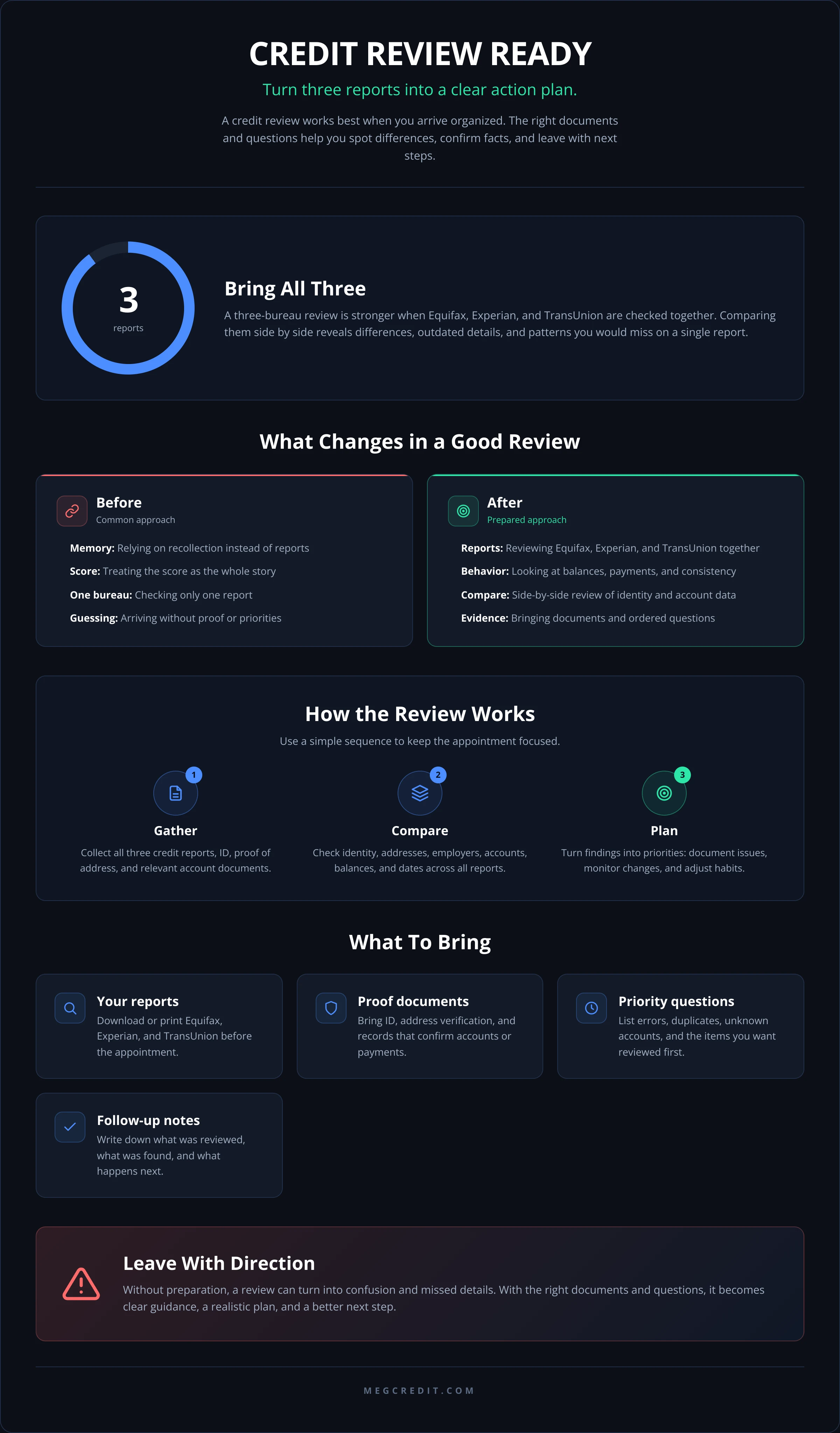
- Gather your reports from all three bureaus before the appointment.
- Identify open accounts, balances, late payments, and outdated personal information.
- Bring documents that confirm your identity, address, and current obligations.
- Write down your questions in order of priority: errors, patterns, and accounts you do not recognize.
- Look for guidance that turns the review into a plan, not just a surface-level conversation.
What to Gather Before a three-bureau credit review
A three-bureau credit review works better when you are not relying on memory. Before you sit down with a specialist, gather the latest reports from Equifax, Experian, and TransUnion, even if they are not identical. The three may show legitimate differences, and that is exactly why it helps to review them together.
It also helps to have your ID, proof of address, and a short list of relevant accounts on hand: mortgage, auto loans, credit cards, student loans, or collections if any exist. You do not need to bring a giant folder; you need to bring what can confirm dates, names, and activity. If you have changed address, last name, or job, that information should be visible from the start.
A common mistake is arriving thinking the review begins and ends with a score. The score matters, but the real insight comes from reviewing behavior, age, utilization, payments, and consistency across reports. If you need a refresher on that part, the guide on how to read your credit report without feeling overwhelmed can help you show up with less mental clutter.
Start with what can be verified
Before interpreting anything, it helps to separate what you can prove from what you only suspect. If an account shows a balance you do not recognize, look for statements, confirmation emails, or prior letters. If an old address appears, note when you stopped using it.
That order prevents vague conversations. When someone brings concrete information, the review stops being a general chat and becomes a useful reading of the file.
How to Check Equifax, Experian, and TransUnion Without Getting Lost in the Details
The most useful review does not start with the “bad” accounts; it starts with comparison. Put the three reports side by side and look first at identity, addresses, employers, open accounts, and key dates. If a detail changes without explanation, that does not always mean an error, but it does deserve attention.
Then look at how each account behaves. A card with a high balance on one bureau and a low balance on another can change your interpretation of overall utilization. An account that appears closed by the creditor on one report and open on another may point to a pending update. This is where checking Equifax, Experian, and TransUnion stops being a nice phrase and becomes a concrete task.
Signs that deserve a slower review
There are findings that do not get resolved with a quick glance:
- accounts you do not recognize;
- late payments with questionable dates;
- balances that do not match across reports;
- names, addresses, or employers that no longer apply;
- duplicate accounts or accounts reported with a different status.
Not every visible error changes your strategy. Sometimes an inconsistency is only a timing issue, and other times it truly affects your profile in a material way. The difference lies in understanding what the data is, who reported it, and how long it has been there.
If you want to compare the basic logic behind personal data handling and disputes, the Federal Trade Commission and the CFPB offer useful consumer guidance. They do not replace a personalized review, but they do help you recognize what is a legitimate signal and what deserves follow-up.
What Documents and Questions to Bring to the Appointment
Showing up prepared does not mean talking a lot; it means asking better questions. Bring a short list of your real concerns: which account should be reviewed first, which information looks duplicated, which late payments need context, and which part of your profile looks strong. A good evaluation should help you tell the difference between urgency and simple noise.
If you are in Orlando and looking for guidance in Spanish, the ideal meeting should include time to explain the practical impact of each finding. Not just “what is wrong,” but what should be prioritized, what should be monitored, and what needs an educational next step. That approach keeps someone from leaving with more anxiety than clarity.
It also helps to be clear about your immediate goal. Some people come because they want to prepare for a future application; others because they found inconsistencies; others because they need to understand their full credit picture before making family or work decisions. Each case changes the kind of recommendation that makes sense.
Questions that truly add value
- Which accounts have the biggest impact on my overall profile?
- Do you see important differences between the three reports?
- Which information looks inconsistent and which is simply outdated?
- What should I monitor over the next few months?
- What habits or decisions are affecting my profile today?
If you want a complementary tool to help you stay organized, you can explore app.iam-eva.ai as administrative support, as long as it does not replace a human review of the reports or responsible interpretation of the data.
How to Use the Review to Build a Realistic Plan
A well-done three-bureau credit review does not end with a list of observations. It should leave you with a personalized credit improvement plan with clear priorities: what to review first, what to document, what to monitor, and what habit to correct. That is where a technical conversation becomes genuinely useful.
For example, if the main issue is high utilization on certain cards, the plan should not focus on “fixing everything,” but on organizing credit use and watching how balances are distributed. If the issue is an account with questionable information, the focus shifts toward documentation and follow-up. If several accounts are correct but the profile has limited history, the strategy will be different again.
This is where it matters not to promise automatic results. A serious review does not guarantee score increases or erase obligations; it turns complex data into responsible decisions. If a company or advisor talks as if every situation ends the same way, be skeptical of the approach.
What should come out of the session
By the end, you should be able to answer three things without hesitation:
1. what we reviewed;
2. what we found;
3. what happens next.
When those three answers are clear, the session is no longer just a report reading and becomes useful financial guidance.
At Magic Enterprise Group, that is the purpose of the process: evaluate, explain, and support with education. A three-bureau review is not meant to scare you; it is meant to give you enough context to make better decisions.
Common Mistakes When Preparing and How to Avoid Them
The most common mistake is bringing overly rigid expectations. Some people show up convinced that everything they see is an error; others assume nothing can be done. Neither stance helps. The useful approach is to arrive with curiosity and evidence, not with a verdict.
Another frequent misstep is checking only one bureau. That leaves out important differences across reports and can cause you to underestimate or overestimate a problem. It also happens that someone focuses so much on one negative account that they miss outdated personal data, duplicate accounts, or status changes that do affect the overall reading.
Some people prepare for the appointment thinking only about debts or late payments. That partial view often leaves out account age, credit mix, and balance trends. To understand those factors better, it is worth going back to five factors that can influence your credit score before the meeting.
Small habits that improve the quality of the review
- Do not arrive without having downloaded or printed the reports.
- Do not assume an old account no longer matters.
- Do not mix budget questions with report questions.
- Do not hide information out of embarrassment; it only delays the diagnosis.
- Do not leave without writing down the agreed priorities.
How to Move Forward After the Review Without Losing Focus
What happens after the evaluation matters just as much as the appointment itself. If you leave with clear action items, keep everything in one place: reports, notes, supporting documents, and follow-up dates. That keeps you from repeating the same analysis every time a question comes up.
It also helps to set a reasonable review rhythm. Checking your credit every day can create anxiety without adding clarity; checking it so rarely that you miss changes is also a problem. The middle ground is orderly follow-up, with judgment and without dramatizing every variation.
If the review showed inconsistencies, follow the process with patience and documentation. If it showed habits you should adjust, focus on behavior rather than only the visible outcome. And if what you need is Spanish-language support to understand the full picture, Services and About us explain the educational approach that works with the Hispanic community in Orlando.
A practical decision for the next step
The best sign of a useful review is that by the next day you already know what you will do with what you learned. It may be gathering a document, organizing an account, monitoring a discrepancy, or scheduling a second review. What matters is that the plan comes from real data, not loose guesses.
If you prefer to do it with support, MAGICENTERPRISE GROUP offers credit guidance in Spanish designed for people who want clarity before acting, not quick promises.
Frequently Asked Questions About Preparing for a Credit Review
What should I bring to a credit review?
Ideally, your three credit reports, ID, proof of address, and any document that helps confirm accounts, addresses, or payments. It also helps to bring a short list of questions ordered by priority.
Why do I need to review all three bureaus instead of just one?
Because Equifax, Experian, and TransUnion may report different information. Reviewing them together helps you spot differences, omissions, or outdated data that you would not see on a single report.
Will the review fix my credit right away?
No. A serious review identifies opportunities, inconsistencies, and priorities; it does not promise automatic changes. It is meant to build a responsible, educational strategy.
What if I find an account I do not recognize?
You should note it, gather documentation, and check how it appears on each bureau. Then it is a good idea to follow up with proper guidance to determine whether it is an error, a mismatch, or something that needs another step.
How often should I check my reports?
It depends on your situation and goals. What matters is maintaining a reasonable and steady follow-up routine, without turning every check into a source of anxiety.
Can I ask for help even if I just want to better understand my credit?
Yes. Many people seek a review not because they have a major problem, but because they want to understand their profile before making decisions. That is a valid reason to ask for guidance.
If you have already spotted differences between your reports or want to feel more confident before your review, schedule Spanish-language guidance through Contact. Bring your questions, your reports, and the context of your situation; we will help you turn that information into a clear, responsible plan.
When you are ready to move from uncertainty to order, write to Magic Enterprise Group and arrange your credit review in Orlando with Spanish-language support.