
If you have an upcoming appointment and do not know where to start, how to prepare for a credit review can feel more urgent than anything else on your to-do list. Many people arrive with the same questions: what documents to bring, what to check first, and how to keep a small detail from turning into a problem in a conversation that could help bring order to their situation.
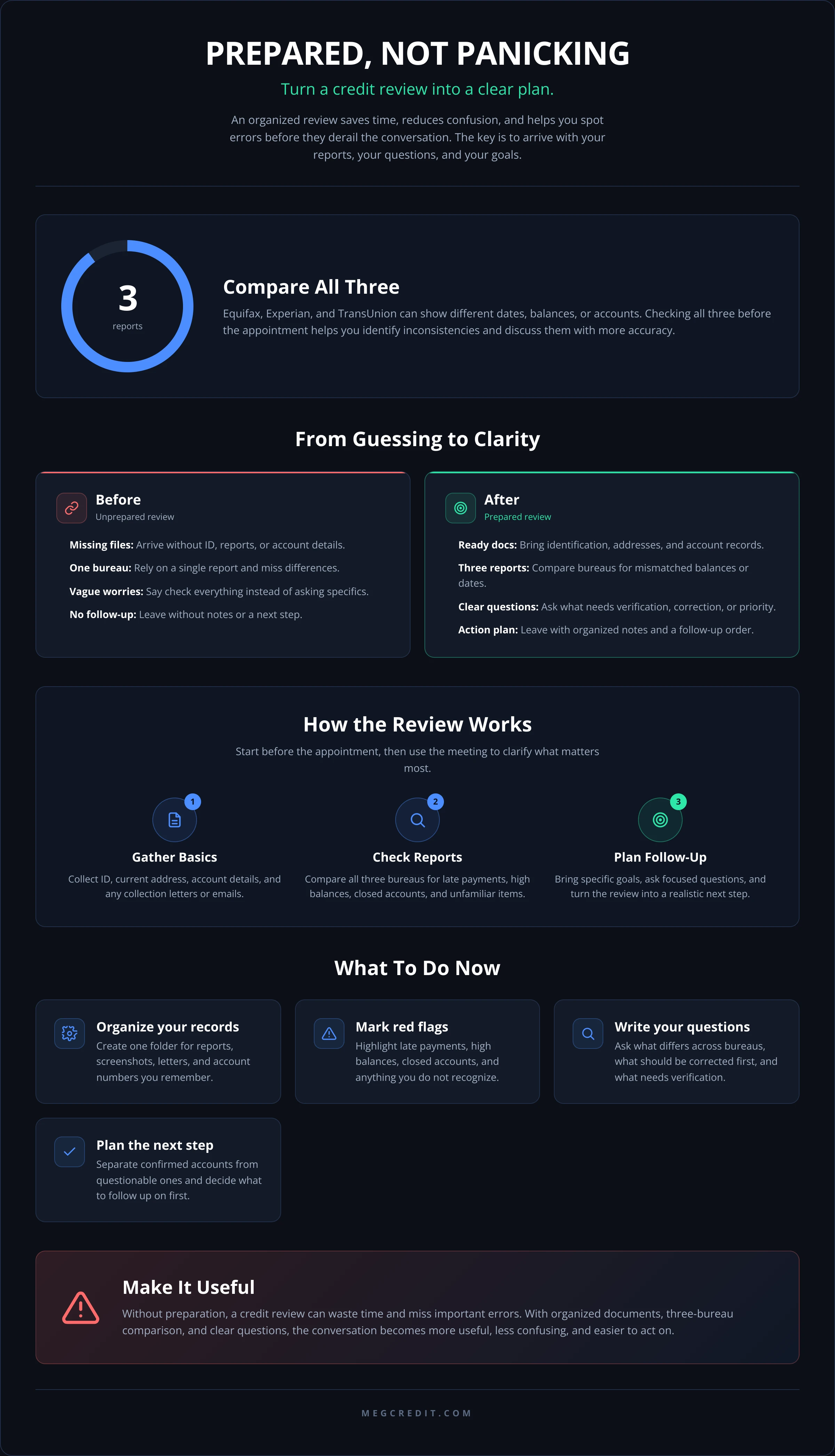
- Gather your information before the appointment: ID, current address, and account details you want to review.
- Check your three credit reports to spot differences between bureaus.
- Mark late payments, high balances, closed accounts, and anything you do not recognize.
- Bring specific questions about your goals: buying a home, organizing debt, or understanding your credit profile.
- Look for Spanish-language guidance if you need to explain your case clearly and without rushing.
How to prepare for a credit review without winging it
When someone shows up without checking anything beforehand, the conversation usually goes off track. Time gets wasted locating basic accounts, deciphering dates, and separating correct information from inconsistencies that were already there. How to prepare for a credit review starts before you sit down with the advisor: arrive with your reports, your questions, and a clear idea of what worries you most.
Think of the review as a route check. You do not need to solve everything that day, but you do need to show up organized. If you know which accounts are causing concern, which ones you have paid on time, and what goals you have in the short term, the session becomes more useful and much less confusing. If you still do not know where to begin, you can start with a simple guide on how to read your credit report without feeling overwhelmed.
The first things you should have ready
Before getting into the technical details, it helps to gather the basics. A valid ID, your current address, account numbers you remember, and any recent collection letters or emails. If you work with printed documents, bring them in order; if you prefer digital files, create a folder with clear, legible screenshots.
It also helps to note recent changes: moves, account closures, past disputes, or payments you made after the statement date. Those details sometimes explain why one report looks different from another. If the process feels overwhelming, the MAGICENTERPRISE GROUP website explains the kind of guidance they offer in Orlando to review credit in Spanish with structure and support.
How to prepare for a credit review by checking your three reports
This is where many people discover that not everything appears the same on Equifax, Experian, and TransUnion. An account may show up on one bureau and not the others, or it may list a different date, a different balance, or a note that does not match. That is why how to prepare for a credit review also means comparing all three reports, not just one.
You do not need to memorize complex terminology. Look for concrete signs: accounts you do not recognize, payments marked late without explanation, incorrect credit limits, paid-off balances that still show as open, and outdated personal information. When someone comes in with that comparison already done, the review usually moves forward with more accuracy.
What to check in each report
Start with the personal information section. An old name, an address you no longer use, or an outdated employer will not always affect your score, but it can reveal that old information is mixed into your file. Then move to open and closed accounts, and check whether the status matches what you remember.
Also look at recent permissions or inquiries. Not all inquiries carry the same weight, but an unfamiliar one can be a red flag if you did not authorize it. If you are not sure how to compare the three files, the Services section shows the three-bureau review approach and personalized guidance the brand works with in Orlando.
Warning signs that deserve attention
There are three situations that usually call for extra care. The first is an account listed as past due even though you remember paying on time. The second is a debt that appears on one bureau but not the other two, which can change the bigger picture. The third is an account you do not recognize and should verify before assuming it belongs to you.
Also pay attention to balances that do not match your records. Sometimes the issue is not a major gap, but a small difference that changes the way the report is read completely. If you still are not clear after checking, credit guidance with an educational focus can help you decide what to ask and what not to overlook.
Common mistakes before a credit review
One of the most common mistakes is showing up expecting an immediate fix without understanding what is being analyzed. A serious review is not about promising fast results, but about identifying real opportunities, inconsistencies, and habits that should be corrected. If someone offers you absolute guarantees, it is better to pause and look more closely.
Another common mistake is hiding information out of embarrassment. Many people stay quiet about collections, late payments, or closed accounts because they fear being judged. That only delays the diagnosis. The review works better when the full picture is on the table, even if it is uncomfortable.
What tends to slow the process down
Arriving without your reports or with blurry screenshots makes the review slower. It also creates problems when you cannot remember approximate dates, creditor names, or the reason for a prior inquiry. If an account was disputed before, it helps to know what happened with that process so you do not repeat steps or mix up complaints.
Another mistake is assuming all accounts carry the same weight in the conversation. An inquiry is not the same as a card with a high balance, a collection, or a line closed years ago. A good advisor helps you sort priorities, but you can save time by bringing a short list of what matters most to you.
Expectations worth adjusting
Do not look for a guaranteed increase promise. Also do not assume every high balance is an equally urgent emergency, or that an old account should be treated like a new one. Each report tells a different story, and the goal is to read it carefully.
If you want a useful reference on which factors usually affect your score, check out five factors that can affect your credit score. That reading helps you arrive at the appointment with a better understanding of why some decisions carry more weight than others.
What questions to bring so you get the most out of the meeting
A credit appointment becomes much more useful when you do not just say, “check everything for me.” Bringing specific questions changes the quality of the conversation. How to prepare for a credit review also means thinking about what you want to understand: whether the main issue is information, credit use, account mix, or the overall structure of your history.
Questions can be simple and still very helpful. For example: which accounts need verification, which data should be corrected first, which factors are affecting your current picture the most, and which habits you can adjust without improvising. You do not need technical language; you need clarity.
Questions that really help
- What is the same and what is different across my three reports?
- Which accounts should be reviewed first because of their impact or inconsistency?
- What personal information should be corrected before making other decisions?
- Which actions depend on me, and which ones require follow-up?
- What habits can I start working on today?
If you want to know how a team works that focuses on education, review, and support, it is worth looking at About and understanding the human approach behind the service. The point is not to sound technical, but to give you a map you can use after the meeting ends.
How to organize your answers
When explaining your situation, avoid telling the whole story at once. Start with what worries you most and then add the context that helps interpret the reports. If there was a move, a job change, a lost document, or a previous dispute, say so from the start.
That order prevents misunderstandings and makes it easier to spot patterns. Sometimes a person thinks they have “a lot of bad accounts,” when in reality there are two duplicate records, an old address, and a history that is not linked correctly. Separating those pieces changes the entire reading.
Responsible strategies after the review
The useful part begins when you leave with clear notes. How to prepare for a credit review does not end with gathering papers; it continues when you turn the review into a realistic plan. The most sensible path is usually to prioritize what can be verified, not what merely looks urgent.
If there are errors, the next step is to document them in an organized way. If there are accounts that are yours but need better management, it is wise to understand which habits are hurting the appearance of your history. If there are questions about balances, dates, or statuses, it helps to follow the trail without mixing up different accounts because they look similar.
A useful plan usually includes
1. Identify what information needs to be corrected or verified.
2. Separate confirmed accounts from questionable ones.
3. Review the usage and payment habits affecting the appearance of your history.
4. Define a follow-up order so you do not lose control.
5. Check in periodically so nothing slips through the cracks.
You do not need to do everything at once. What matters is that the review does not stay as a one-time conversation. With follow-up, the process becomes easier to understand and less reactive.
When additional support makes sense
If you see several inconsistencies across different bureaus, if your reports show information you do not understand, or if you simply have trouble making sense of what you are reading, getting help can save time. A service like Preparing: How to Prepare for a Credit Review can be a helpful reference if you want to arrive better organized for an appointment.
It is also useful to rely on outside tools when you need help tracking habits, calendars, or documents. Platforms like EVA can be a helpful complement for staying organized, although credit interpretation still requires human judgment and real-world context.
Financial education to keep the change going
A one-time review helps, but financial education is what keeps the same mistakes from happening again. Understanding how credit history is built, how reports are read, and which actions tend to have the biggest impact gives you more room to act without anxiety. That is often what makes the difference between putting out a fire and learning how to avoid the next one.
In Orlando, many Spanish-speaking people prefer direct explanations without confusing language. That is where a Spanish-language guide adds real value: it translates concepts, organizes the conversation, and makes it easier to make decisions with less uncertainty. When that is done well, the person understands what they are seeing better and stops relying on guesswork.
Habits worth reviewing carefully
Check whether your payments are being recorded on time, whether you have more open accounts than you can easily keep an eye on, and whether there are balances that deserve more disciplined attention. Also think about how often you review your reports. Waiting until there is a problem to read them usually costs time and creates confusion.
If you prefer ongoing guidance instead of a single appointment, that makes sense too. What matters is that help does not take away your independence, but teaches you to recognize patterns and make more informed decisions. That approach is part of the work MAGICENTERPRISE GROUP offers to the Spanish-speaking community in Orlando.
Frequently asked questions about preparing for a credit review
What should I bring to a credit review?
Bring a valid ID, details of your main accounts, your three reports if you already have them, and any letters or notices related to payments, collections, or disputes. If you can, add a short list of questions so you do not forget what you want to resolve.
Do I need to check all three bureaus before the appointment?
Yes, if you can. Equifax, Experian, and TransUnion do not always show exactly the same information. Comparing them beforehand helps you spot differences, unfamiliar accounts, and inconsistencies worth discussing in an organized way.
What should I do if I find an account I do not recognize?
Do not assume it is yours right away, and do not ignore it. Write down the creditor name, account status, and which bureau it appears on. Then ask for guidance on how to verify it before making any other decision.
Does a credit review guarantee results?
It should not be presented that way. A review is meant to help you understand your situation, identify opportunities, and build a responsible plan. The outcome depends on what appears in your reports and how follow-up is handled.
How often should I check my credit?
It depends on your goals and your current situation, but you should not wait until there is already a problem. Checking it regularly helps you catch changes, errors, and new inquiries before the picture gets complicated.
If you want to arrive at a review with clarity and without feeling like you are missing context, schedule Spanish-language guidance with Magic Enterprise Group. A well-prepared conversation can save you confusion and help you organize your reports with a plan you can actually follow.
If you are in Orlando and would rather review your three bureaus with educational support, contact us here to take the next step with clear information and no pressure.