
If you’re about to apply for a mortgage, rent an apartment, buy a car, or simply understand your profile better, you probably already feel that mix of urgency and clutter. Knowing how to prepare for a credit review doesn’t start on the day of the appointment: it starts when you gather your reports and decide to look at what is really going on.
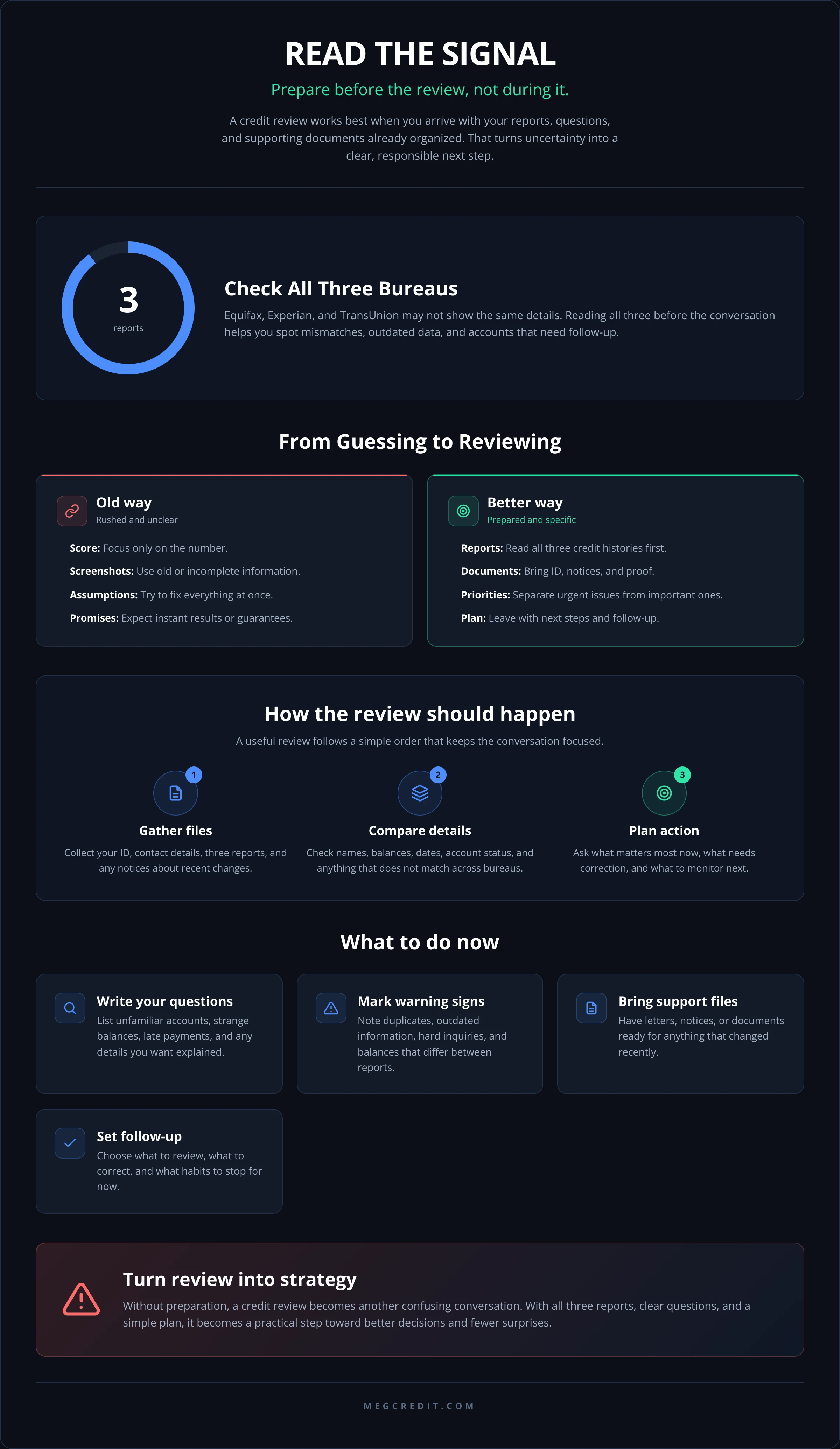
- Review all three reports before any conversation.
- Identify errors, duplicate accounts, and outdated information.
- Separate what is urgent from what is important so you don’t rush decisions.
- Bring specific questions about your history, not just your score.
- Use the review as the starting point for a responsible plan, not as a promise of results.
How to prepare for a credit review without winging it
The first useful decision is simple: stop looking only at the score. The number helps provide direction, but a serious review starts with the reports from Equifax, Experian, and TransUnion, because that is where you’ll find the history, balances, dates, open accounts, and details that may explain why your profile looks better or worse than you expect.
If you prepare well, you arrive with less anxiety and better questions. That changes the conversation completely. Instead of asking for a “quick fix,” you can ask for a realistic reading of your situation, something MAGICENTERPRISE GROUP works on frequently in Orlando for people who need guidance in Spanish and want to understand their reports before taking the next step.
Gather what you actually need
Before scheduling a review, gather your ID, current contact details, and access to your three reports. If you haven’t downloaded them yet, use the official channels and avoid relying on old screenshots or incomplete summaries. The most reliable source for requesting reports is AnnualCreditReport.com and, if you want to better understand the technical language, the Consumer Financial Protection Bureau has helpful materials in Spanish.
It also helps to keep on hand any letter, notice, or document that explains a recent change: an account closed, a billing dispute, a delinquency you believe is incorrect, or a balance that changed unexpectedly. This isn’t about bringing a perfect folder; it’s about avoiding a conversation built on guesswork.
How to prepare for a credit review with your three reports
The most important part is not printing them, but reading them with intention. A report doesn’t tell just one story; it tells three versions that may or may not match. That is where the real work begins: comparing dates, creditor names, balances, limits, account statuses, and any sign of inconsistency.
If you’ve never reviewed a full report, a guide like how to read your credit report without feeling overwhelmed may help, because the problem is usually not a lack of information but too much data without order. And if you’d rather first identify the factors that weigh most in your profile, it also helps to review five factors that can affect your credit score.
What to look for first in Equifax, Experian, and TransUnion
Start with the basics: name, address, partial Social Security number, reported employment, and accounts listed as open. Then check whether balances match across bureaus, whether there are late payments you do recognize, and whether there are accounts you don’t remember opening. When something appears differently in each report, it doesn’t always mean fraud; sometimes it’s just an update delay. But it does deserve attention.
Make a three-column list of findings: “matches,” “question,” and “don’t recognize.” That structure saves time during the review and keeps an important conversation from turning into a scattered one. If a closed account still shows activity, or a credit limit appears incorrect, that detail can affect the reading of your profile even if it doesn’t seem serious at first glance.
Warning signs worth writing down
Some signs often go unnoticed until someone reviews them carefully. For example: duplicate accounts, balances reported with large differences between bureaus, opening dates that don’t line up, late payments that should already have been updated, or collections that appear without enough context. It’s also worth marking recent hard inquiries, because too many applications in a short period can change the perception of risk.
If you notice obvious errors, don’t try to fix everything at once or jump to conclusions. A responsible review separates what is a documentation error, what needs follow-up, and what simply reflects a financial habit that needs to change. That distinction prevents frustration and, above all, keeps you from wasting energy on the wrong problem.
Reading the findings the right way
This is where many people rush. They see a late payment, a collection, or high utilization and want to know “how to erase it.” But a healthy strategy is not about erasing; it’s about understanding what happened, what can be corrected, and what behavior needs to change so the profile doesn’t keep accumulating friction.
A professional review can help you distinguish between an inconsistency, a current obligation, and an account that no longer has practical impact because it is close to dropping off your history. That reading changes priorities. Sometimes the urgent move is not disputing a line; it’s organizing payments, reducing imbalances, and avoiding new negative marks while the rest gets resolved.
Questions to ask during the review
Bring specific questions. Don’t ask only whether things are “good or bad”; ask which account matters most right now, which discrepancies are worth reviewing first, and what action would be most responsible over the next 30, 60, or 90 days. Also ask whether the reports show a credit-use pattern that should be adjusted before applying for something new.
If your situation is sensitive, a clear explanation is worth more than a quick answer. In Orlando, many Spanish-speaking people look for more than a technical reading; they want an explanation they can understand without unnecessary jargon. That’s where financial education makes the difference between reacting on impulse and building an orderly plan.
What you should not promise yourself
Don’t promise yourself an instant fix or a guaranteed change in your score. Also don’t assume a dispute will solve everything or that one account defines your entire profile. Credit usually improves when a person stops improvising and starts following a consistent plan: review, correct, organize, and then monitor.
If an advisor explains risks, timelines, and real limits, they’re giving you a useful tool. If someone offers shortcuts without reviewing your reports, it’s best to be skeptical. A good review process doesn’t sell miracles; it organizes information and turns findings into responsible decisions.
A responsible strategy after the review
A credit review only matters if it ends in a plan. That plan doesn’t have to be complicated, but it does need to be personalized. Two people with similar scores may need very different actions: one may need to correct information errors, while another may need to improve use of available credit or regularize payments to avoid new negative marks.
In services like Services, the value is not in “promising” but in translating the reports into concrete steps. That may include follow-up, side-by-side reading across bureaus, and guidance that helps you avoid repeating the same problem next month.
What a useful improvement plan looks like
A useful plan starts from observable facts. For example: accounts to review first, payments that need organization, documented inconsistencies, and habits that must change before requesting financing again. It also includes follow-up dates, because without follow-up, the review becomes a single snapshot.
There’s no need to complicate it with dozens of goals. Often, a good plan focuses on three things: what to review, what to correct, and what to stop doing for now. If you do it well, the review stops being a one-time conversation and becomes a responsible credit strategy.
Financial education that actually helps
Education matters because many credit problems don’t come from one bad decision, but from a series of small repeated ones. Understanding how payments are reported, why balances change, and what effect opening accounts without a real need can have helps you avoid mistakes that later consume time and energy.
It also helps to learn how to read your history without swinging to extremes. Not every error calls for panic, and not every late payment fixes itself. Clear guidance lets you act with judgment, without confusing hope with strategy.
Habits that strengthen your profile while you wait for results
While reports are being reviewed or inconsistencies are being corrected, there are decisions that do depend on you. Paying on time, avoiding unnecessary inquiries, not opening accounts on impulse, and watching your credit utilization are simple steps, but they have a real impact on your profile’s health.
If you want to go deeper later, the MAGICENTERPRISE GROUP blog offers materials designed for anyone who needs to better understand the process without feeling lost. And if you want to complement that with a conversational support tool to organize your questions, you can explore solutions like iam-eva.ai, always using your own judgment and not replacing human review when the case calls for it.
Common mistakes that make the review harder
One of the most frequent mistakes is showing up without having read the full reports. Another is assuming all old accounts no longer matter. It also creates problems not to bring supporting documents or to mix different goals in the same conversation: trying to correct data, seek approval, and resolve debts in the same week usually ends in confusion.
There is an even costlier mistake: accepting generic explanations without asking for details. If someone reviews your credit with you, you should leave understanding what was seen, what still needs to be reviewed, and what the next step will be. If you leave just as confused, the review didn’t do its job.
When to ask for support in Orlando
There are times when it makes sense to stop guessing. If you found differences between bureaus, if several accounts show confusing information, if you’re worried about an important application, or if you simply don’t know where to begin, asking for help can save you time and mistakes. In a city like Orlando, where many families manage tight budgets and very concrete financial decisions, a clear review brings peace of mind and direction.
About explains the educational approach and the Spanish-language guidance that supports this process. And if you just want to see what kind of help exists before speaking with someone, you can also check Blog to identify the kinds of questions that usually come up during a review.
What to expect from serious guidance
You should expect analysis of all three bureaus, observation of inconsistencies, a simple explanation of the findings, and a personalized plan that doesn’t push you toward rushed decisions. You should also expect follow-up, because reports change and priorities change with them.
Serious guidance doesn’t treat you like a generic case. It takes into account your goals, your time, your income, and the real order of your obligations. That approach is often more useful than any flashy promise.
Frequently asked questions
How do I prepare for a credit review if I’ve never checked my reports?
Start by getting your three reports and marking anything you don’t understand: unfamiliar accounts, strange balances, late payments, old addresses, or duplicate information. Bring those questions in writing so you don’t forget anything during the review.
Do I need a high score to ask for a review?
No. A review is especially useful when you want to understand why your profile looks a certain way and what you should check before making financial decisions. A low, middle, or high score can all benefit from an organized reading.
What happens if I find errors in Equifax, Experian, or TransUnion?
First document what you see and compare it across reports. Then decide whether it’s an information error, a pending update, or an account that needs further follow-up. A responsible review doesn’t wing it; it prioritizes.
Does a credit review guarantee my score will go up?
No. No serious person should promise guaranteed results. What a well-done review can offer is clarity about your reports, a personalized plan, and guidance to avoid decisions that could make your situation worse.
How long does it take to get my documents ready?
It depends on how organized your reports and personal information already are. If you already have your three reports and supporting documents, preparation is usually much faster and the session can focus on what matters.
Can I ask for help even if I only want to understand my situation before applying for credit?
Yes, and in fact that is often the best time. Preparing before an important application reduces mistakes and helps you make decisions with more context.
If you want to move from uncertainty to a clear review, schedule your guidance through Contact. Bring your three reports, your questions, and any document that concerns you; that way the session is truly useful and you can leave with a responsible plan, not another round of uncertainty.
If you’re in Orlando and want a Spanish-language look at your Equifax, Experian, and TransUnion reports, MAGICENTERPRISE GROUP can help you organize the information, spot inconsistencies, and define the next step with sound judgment.