
How to recognize responsible credit repair
Responsible credit repair is not about shortcuts. It starts by reviewing your current situation, identifying inconsistencies, and explaining which parts of the report can be reviewed and which ones do not depend on outside action.
That difference matters a lot. Some people offer to “clean up” your history as if everything were negotiable. In reality, a serious service works with the information shown on all three reports, identifies possible errors, helps you understand the impact of each account, and guides you on the next steps without making up results.
If a company avoids talking about financial education, does not show its method, or changes its message depending on what you want to hear, that is already a warning sign. Responsible credit repair stands out because it leaves you with a clearer picture, not a more confusing one.
What it should include
A trustworthy service usually shows you an organized process. It does not need to be complicated; it needs to be clear.
Look for:
- Review of all three bureaus: Equifax, Experian, and TransUnion.
- Reading of open and closed accounts, inquiries, and reported balances.
- Detection of inconsistent or incomplete data.
- Explanation of what may affect your profile and what may not.
- A personalized plan you can follow without improvising every week.
To prepare more effectively, it can also help to review a guide to preparing for a credit review before meeting with a specialist. Coming in with basic documents and your questions organized saves time and avoids misunderstandings.
Warning signs worth taking seriously
There are phrases that should make you pause right away. When you hear about guaranteed results, automatically removing negative history, or fixing everything without reviewing your reports, they are not describing a realistic process.
Another common red flag is a lack of transparency. If they do not explain what they will do with your information, if they do not distinguish between guidance and promises, or if they pressure you to decide the same day, the service is more focused on closing a sale than on helping you.
Language also matters. A serious provider does not need to sound aggressive. In fact, responsible credit repair usually uses an educational tone, because the goal is for you to understand your reports and make better decisions, not to depend on exaggerated messages.
Promises that should make you doubt
You do not need to memorize an endless list. Just recognize patterns.
Be skeptical if they offer:
- A guaranteed score increase.
- Debt removal as if all debts were interchangeable.
- “Deleting” negative marks without reviewing context.
- Mass disputes without explanation.
- Charging you before showing a clear plan.
If any of those phrases appear, ask for concrete details. What do they review? What do they deliver? How do they measure progress? What happens if an item on the report is accurate and cannot be disputed? An honest provider will not be bothered by basic questions.
To better understand how each part of the report connects to your profile, you can read how to read your credit report without feeling overwhelmed. It helps a lot when you still do not know the difference between an inquiry, a closed account, and a reported balance.
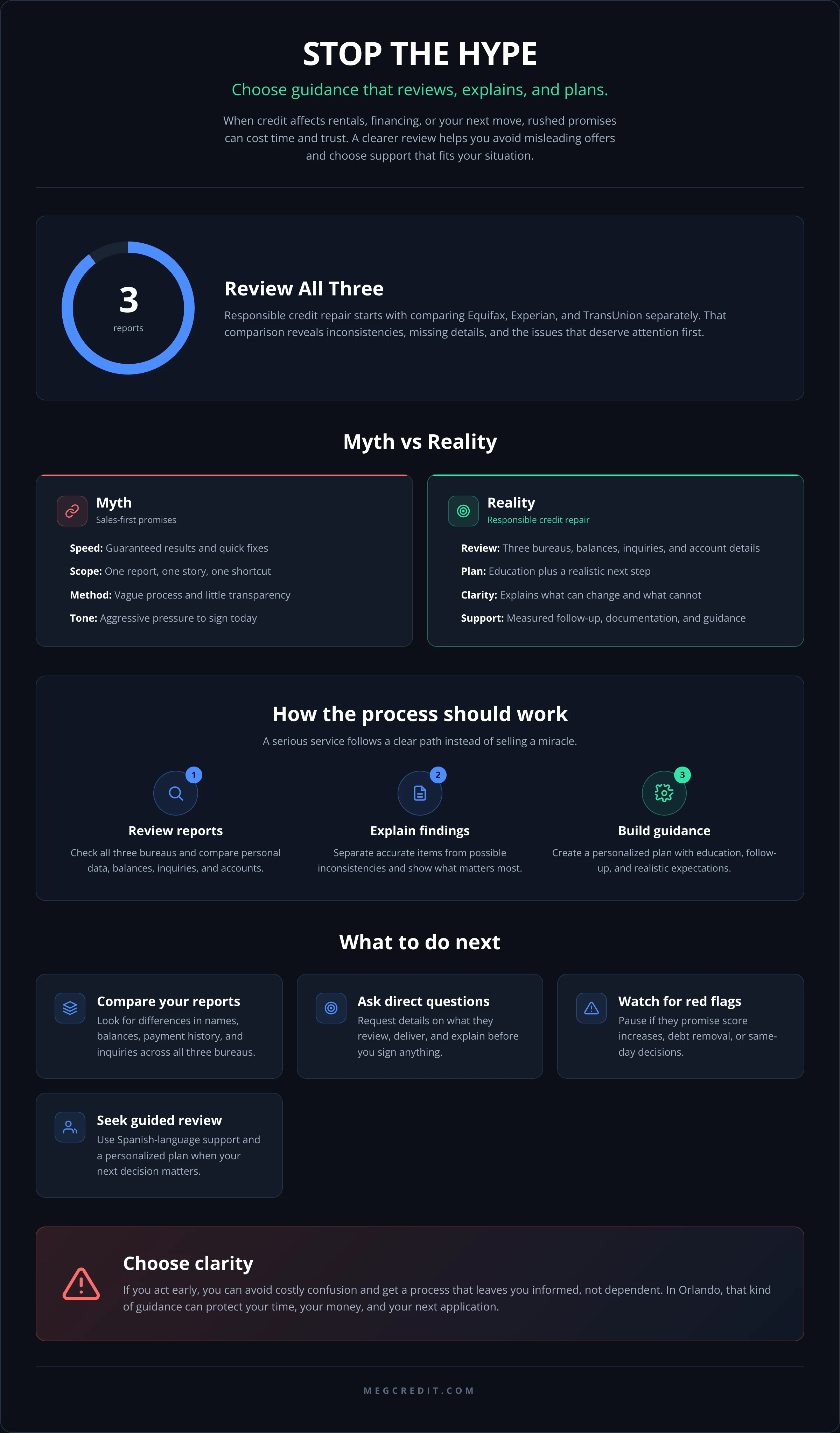
What to review in your three reports before hiring someone
Not everyone has exactly the same history across all three bureaus. That is why responsible credit repair reviews Equifax, Experian, and TransUnion separately, not as if they were one single snapshot.
The useful part here is comparison. An account may appear on one report and not another, dates may differ, balances may not match, or there may be inquiries you do not remember. That comparison does not solve everything by itself, but it does show where the real opportunities for review are.
For general information, consult the Consumer Financial Protection Bureau.
Data worth comparing
Take a calm look at these points:
- Name, address, and personal information.
- Active and closed accounts.
- Payment history.
- Reported balances.
- Recent inquiries.
- Notes or remarks on specific accounts.
If you do not know where to start, guidance with Equifax, Experian, and TransUnion report analysis can help you prioritize. The value lies in organizing what you see, not in filling the conversation with technical jargon.
It also helps to understand that not every visible error changes your financial life immediately. Some inconsistencies matter more than others, and a good review should tell you which ones deserve attention first.
How to compare proposals without getting confused
When several options say they can help with credit, it is easy to choose based on price or speed. But a serious proposal is recognized by how it explains the work, not by how flashy the ad is.
Ask them to describe the exact scope. Will they do a three-bureau credit review? Will they provide a personalized credit improvement plan? Will there be follow-up and credit guidance? If the answer is vague, the service probably is too.
Responsible credit repair does not need to sound perfect. It needs to be understandable, measurable, and consistent with your situation. If instead they talk as if credit were some mysterious process only they can handle, they are probably hiding gaps behind marketing language.
Useful questions before signing
These questions often help organize the conversation better:
- What exactly do you review in my report?
- Will you explain which findings are accurate and which are not?
- What kind of guidance do you offer after the review?
- What does a personalized plan look like in my case?
- Does the approach include financial education about credit?
If you also want to learn about a firm that serves the Spanish-speaking community in Orlando, you can review MAGICENTERPRISE GROUP and see how it structures its services. It is also worth looking at the services section to understand what is included in a review and guidance-focused consultation.
You do not need to decide right away. In fact, a short pause usually helps more than an impulsive signature. If an offer cannot handle simple questions, it will hardly stand up to a serious process.
Financial education and follow-up: the part many people overlook
Some people only want to “fix” their credit, but then they repeat the same habits that made things harder in the first place. That is why the educational piece matters just as much as the initial analysis.
Good support helps you read your reports more carefully, understand how accounts are reported, and decide which changes actually depend on you. That is where financial education about credit comes in: not as theory, but as a way to make better decisions with cards, payments, inquiries, and overall credit use.
Follow-up also matters. A one-time review can show you a snapshot; ongoing support helps you stay on track. When guidance is continuous, you can review progress, adjust habits, and avoid mistakes that throw your profile off balance again.
When to ask for extra guidance
Asking for additional support does not mean you are behind. Sometimes it means you have already seen something that is worth interpreting correctly.
Look for follow-up if:
- You do not understand why an item appears on one bureau and not another.
- Your income or housing situation has changed.
- You are about to apply for a rental, financing, or a new product.
- You have several accounts and do not know which one to address first.
- You want to stop improvising and start with an organized plan.
If you want to go deeper into the factors that influence your profile, check out five factors that can influence your credit score. That reading complements a review very well, because it helps you see the behavior behind the number.
Choosing well in Orlando without losing time or clarity
In Orlando, many credit decisions are made under pressure: rentals, moves, cars, job changes. That is exactly why responsible credit repair should help you understand your situation without promising more than it can deliver.
This is where Magic Enterprise Group’s approach is useful for people who prefer Spanish-language support. The difference is not in talking about credit, but in reviewing all three reports, identifying opportunities and inconsistencies, and building an educational strategy that makes sense for your case.
If you want to work with a three-bureau credit review, a personalized credit improvement plan, and realistic guidance, the important thing is to choose a team that does not treat you like just another sale. The process should leave you better informed, not more dependent.
Serious support also avoids paths that are not part of responsible guidance: it does not promise a guaranteed score increase, it does not sell magic solutions to eliminate debts, it does not offer personal loans, and it does not mix in services that do not belong. That boundary, even if it seems simple, protects your time and your expectations.
To learn more about the brand’s approach and work, you can also review the about us section and the blog, where helpful topics are expanded for people who want to learn how to manage credit better.
When it is worth asking for a review
There are moments when waiting does not help.
Ask for a review if:
- You have already checked your reports and found data you do not understand.
- You are about to make an important decision and want to be better prepared.
- You need order before looking for a rental or financing.
- You feel your history is stuck because of old habits you want to fix.
If what you need is clarity, responsible credit repair starts long before any dispute or follow-up: it starts with understanding your full situation. And for many people, that already changes the way they act.
Frequently asked questions
#### What does it mean to repair credit responsibly?
It means reviewing your information carefully, identifying real inconsistencies, explaining what can and cannot be done, and following a plan based on education and guidance, not quick promises.
#### Why is it important to review all three bureaus?
Because Equifax, Experian, and TransUnion may show different information. Comparing them helps detect differences, incomplete data, or accounts that deserve a closer look.
#### Does responsible credit repair guarantee a higher score?
No. No serious provider should guarantee a specific outcome. Credit depends on several factors, and every profile responds differently.
#### What should a credit review give me?
Ideally, a clear reading of your reports, relevant findings, an explanation of opportunities, and a personalized credit improvement plan with practical guidance.
#### Is financial education part of the process?
Yes, when the service is complete. Understanding how your credit behaves helps you maintain changes over time and avoid repeated mistakes.
#### Where can I get guidance in Orlando?
You can request a review and initial conversation with Magic Enterprise Group to go over your case in Spanish and receive guidance that fits your situation.
If you want to stop guessing what to do with your history, schedule a conversation at contact. A serious review helps you see your reports more clearly and decide on the next step without falling for empty promises.