
When an application asks for your Social Security number, income, and rent, but your approval cools off because of a credit review, doubt usually hits the report first. Many people search how to read my credit report right after getting a denial, a high rate, or a note they do not understand.
- Your score does not change because of one detail alone; it usually reflects several habits and records at the same time.
- The credit report shows concrete clues: payments, balances, age, inquiries, and account types.
- A small error can throw off the analysis and make you think the problem is something else.
- Checking all three bureaus helps reveal differences among Equifax, Experian, and TransUnion.
- An organized reading avoids impulsive decisions and lets you act with better judgment.
A guide on how to read my credit report without losing details
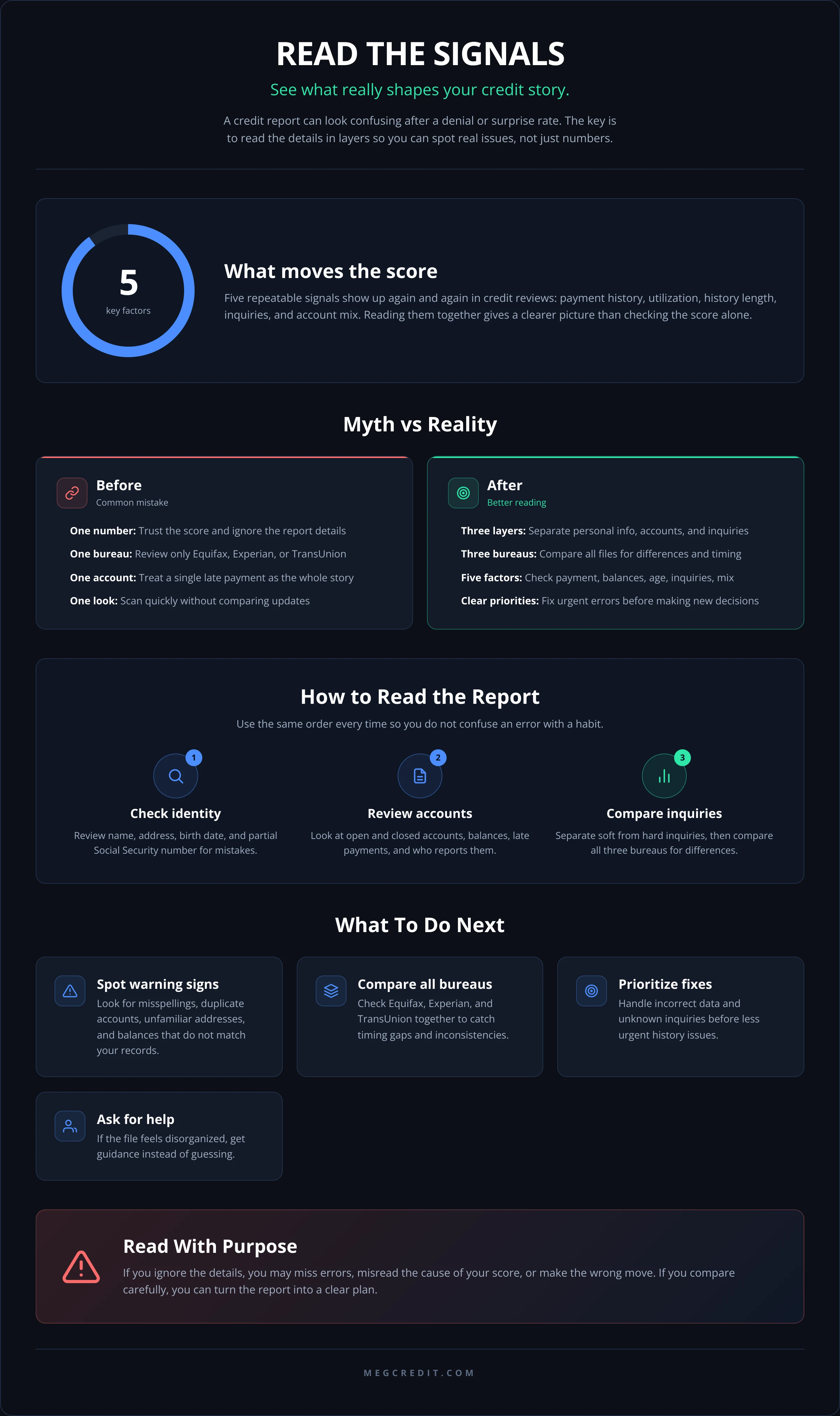
Reading a credit report is not about finding a big number and assuming everything else does not matter. If you want to understand how to read my credit report, start by separating three layers: your personal information, account history, and inquiries. That division helps avoid mixing an identity error with a real late payment or with an account that was closed a long time ago.
First check your name, address, date of birth, and partial Social Security number, when it appears. Then move on to open and closed accounts, where it matters to see who reports the account, when it began, what the most recent balance was, and whether there were late payments. At the end, look at the inquiries, because not all of them carry the same weight or serve the same purpose.
If you prefer a step-by-step guide for that initial review, the companion article how to read your credit report without feeling overwhelmed may help. And if you need a broader overview of the process, at MAGICENTERPRISE GROUP they explain how they work with the Spanish-speaking community in Orlando without turning the topic into a cold list of acronyms.
Five factors that can influence your credit score when you review the report
Scoring models take several signals at once, but five tend to show up again and again when someone analyzes their history. If you are trying to understand how to read my credit report, these are the areas worth observing most carefully.
Payment history
On-time payment is usually the most visible signal on the report. A 30-, 60-, or 90-day late payment is not interpreted the same way as an account in good standing, and the difference can be clearly seen in the payment section of each account. If a card, loan, or utility account reports a late payment, that data can weigh down the perception of your history for quite some time.
Everything does not have to be “bad” for one missed payment to stand out. Sometimes a person is current on almost everything, but a forgotten account, a misfired transfer, or confusion over a due date changes the picture. That is why report reading should look for patterns, not just an isolated incident.
Credit utilization
This point often raises more questions than it should because many people focus only on the limit. What matters is how much of the available credit is being used relative to that limit, especially on revolving cards. When a balance gets too close to the ceiling, the report can reflect heavy dependence on available credit.
The statement closing date matters here too, not just the day you pay. A card may seem “well managed” if you already made a payment afterward, but the previous month’s report may have captured a high balance. If you are reviewing how to read my credit report, it is worth looking at the reported balance and not only the current status in your banking app.
Length of credit history
The age of your accounts often says more than it seems. Not all accounts carry the same weight, and an older account with good behavior can add positive context to the history. When someone closes old accounts without understanding the effect, they sometimes reduce the average age of the file and leave less useful information for the analysis.
It also helps to distinguish between an open account, an account closed by the consumer, and an account closed by the creditor. Each one tells a different story. In a serious review, age is not seen as an isolated number, but as the way the history has matured over time.
Recent inquiries
Hard inquiries, when they come from credit applications, can show that several searches were opened in a short time. That is not always bad, but it does deserve context. If there are inquiries you do not recognize, or several applications concentrated in a short period, it is worth investigating right away.
Soft inquiries, by contrast, usually do not have the same impact or purpose. That is why it is a mistake to read that section with the same logic across the board. The report only makes sense when you separate what counts as an informational review from what reflects a formal application.
Account mix and overall behavior
Having only one type of account can make the history look narrower than it really is. Models usually look at whether there is variety among cards, installment accounts, and other credit relationships, although mix by itself does not make up for late payments or heavy balances. What matters is consistent behavior across that mix.
If someone uses only a few accounts but handles them with discipline, the report may look more organized than that of someone with many lines but uneven signals. That is why, when learning how to read my credit report, it is not wise to obsess over opening new things before reviewing what is already reporting.
Warning signs worth spotting before making decisions
Some reports read quickly because everything seems to be where it should be. Others need a more patient look because they show inconsistencies that change the whole reading. A misspelled last name, someone else’s account mixed with yours, or a balance that does not match your records can throw off the analysis if you do not catch it in time.
The most useful warning signs are not always the loudest ones. A statement with a late payment you do not remember, a limit that differs from what the institution shows, a duplicate account, or an unfamiliar address can point to an administrative issue, a reporting error, or an identity match. At that point, the question is no longer just how to read my credit report, but how to interpret what appears with judgment before acting.
For anyone who wants a more organized framework for these details, the guide on how to prepare for a credit evaluation helps you arrive with clearer documents and expectations. And if you need to consult official definitions about reports, the Consumer Financial Protection Bureau maintains useful explanations about credit and consumer rights.
Common mistakes when reviewing the report on your own
One of the most common mistakes is assuming that if an account appears, then the information must be correct. Another is checking only the score and ignoring the details behind it. It also happens that someone looks at just one bureau and thinks they have seen everything, when in reality the picture can change between Equifax, Experian, and TransUnion.
An incomplete review can lead to weak decisions: paying something that was not necessary, ignoring a real inconsistency, or applying for a new product without knowing what is affecting the file. If the goal is to improve credit management, the reading should be methodical and comparative, not a five-minute glance.
Checking all three bureaus changes the full reading
One version of the history does not always tell the whole story. That is why, when someone searches for how to read my credit report, checking all three bureaus reveals important differences: an account may appear in one and not another, a balance date may change, or an inquiry may be reported differently.
That contrast does not automatically mean there is a serious error, but it does mean you need to ask why the difference exists. Sometimes the cause is the update timing; other times, it is a data upload that did not sync the same way everywhere. The real value lies in comparing without jumping to conclusions.
In Services it is explained how a three-bureau credit evaluation helps spot opportunities and inconsistencies before building a plan. That cross-check can be especially useful if you live in Orlando and want guidance in Spanish that respects your real situation.
What changes when you view Equifax, Experian, and TransUnion together
The three reports do not always move at the same pace. A new account may appear first in one bureau, a balance update may take time to show up in another, and a correction may appear in one file before the others. For someone trying to interpret the history without help, that difference can look like a mess, when in reality it is part of how reports normally work.
That is why reading them together avoids incomplete diagnoses. It also makes it possible to spot patterns: if a problematic account appears the same way in all three, the signal is more consistent; if it appears in only one, it needs a closer look before assuming the impact will be the same everywhere.
What to do after identifying the factors that affect your history
A good reading does not end with the discovery; it ends with a useful decision. If you already found late payments, high balances, recent inquiries, or a suspicious account, the next step is to set priorities. Not everything gets fixed at once or with the same move, and that is why a generic plan often falls short.
The smartest move is to separate what is urgent from what is important. Urgent issues may include an account with incorrect data or an inquiry you do not recognize. Important issues usually lie in the pattern: the way cards are used, payment discipline, and the consistency of the file. That is where a well-done reading starts turning into strategy.
If you want to understand how that analysis turns into concrete steps, you can review financial education about credit and factors that influence your score. And if you want to learn more about the team and their responsible guidance approach, the About Us section shows the kind of support they offer without promising shortcuts.
What a personalized credit improvement plan looks like
A useful plan does not begin with promises; it begins with priorities. It may include reviewing duplicate accounts, organizing payment dates, watching balances that are reported too high, or identifying which accounts to monitor first. It can also include simple habits, like checking your reports at a reasonable frequency and keeping backup copies when something changes.
In a serious advisory process, the plan is not written the same way for everyone. The story of a self-employed worker, that of a family that just moved to Orlando, or that of someone who regained stability after several financial changes are not read the same way. That is why an educational approach often leads to better decisions than a quick formula.
Credit education for the Spanish-speaking community in Orlando
Many credit problems do not come from one huge mistake, but from a lack of context. Someone pays late because they did not understand the billing cycle; another person closes an account because they think that will “clean up” the history; another uses almost all of their limit without knowing how it is reported. The result is the same: the report tells a story that does not match what that person thought they were doing.
When support is provided in Spanish and with an educational focus, the conversation changes. The person understands what they are seeing, what it means, and which steps make sense in their case. That is especially valuable in a city like Orlando, where the Spanish-speaking community often manages multiple responsibilities at the same time and needs clarity, not jargon.
If you are interested in reading practical content with that same approach, the blog brings together articles that explain credit in a way that feels closer to everyday life. And if you want to understand how guidance can help you organize the report without wasting time or taking unnecessary risks, MAGICENTERPRISE GROUP works with exactly that goal.
When to ask for help instead of guessing
If you have already checked several reports and still see data you do not understand, it may be better to stop improvising. It also makes sense to ask for support when there are many open accounts, frequent address changes, inquiries you do not recognize, or major differences among the bureaus. The more disorganized the file is, the easier it is to misread a signal and make a decision that is not useful.
Professional help makes sense when the goal is to understand, compare, and prioritize. You do not need to arrive with everything figured out; you just need to want to read the report more clearly and be ready to act on what is actually there. That is where the analysis stops being confusing and starts being useful.
Preguntas frecuentes sobre cómo leer mi reporte de crédito
¿Cada cuánto debo revisar mi reporte de crédito?
It depends on your situation, but checking it regularly helps you spot changes, unfamiliar inquiries, and identity errors. If you are working on understanding how to read my credit report, doing it on a regular basis lets you compare how your history evolves.
¿Un solo atraso arruina todo mi reporte?
Not necessarily, but it can affect the overall reading of the history. The impact depends on which account it was, how much time has passed, and whether there were other similar signals. That is why it is best to look at the full pattern instead of one isolated line.
¿Por qué mis tres reportes no muestran exactamente lo mismo?
Because each bureau may update at different times and not all creditors report in the same way. When reviewing how to read my credit report, comparing the three files helps you notice differences that deserve clarification.
¿Qué hago si encuentro una cuenta que no reconozco?
First check whether it could be a business name, a closed account, or a reporting variation. If you still cannot identify it, gather your records and seek guidance before assuming the data is correct or incorrect.
¿El saldo de mis tarjetas afecta aunque yo pague a tiempo?
Yes, because the level of usage is also reflected in the report. Sometimes a person pays after the closing date and sees their balance normalized in their bank app, but the report has already captured high utilization.
¿Leer el reporte me sirve aunque no vaya a pedir crédito pronto?
Yes. Understanding your history gives you time to correct data, organize habits, and avoid surprises. When the time comes to apply for a mortgage, a car loan, or a card, you will already have a clearer foundation.
If you want to review your three reports with guidance in Spanish and without guessing what part is affecting your profile, schedule an evaluation with Contact. At Magic Enterprise Group, they help you read the report, spot opportunities and inconsistencies, and build a responsible plan based on your real situation in Orlando.
If you would rather take the first step calmly, write through Contact and ask for a review focused on your three bureaus. You do not need to show up with everything understood; just bring your report and the right question to start organizing it.