
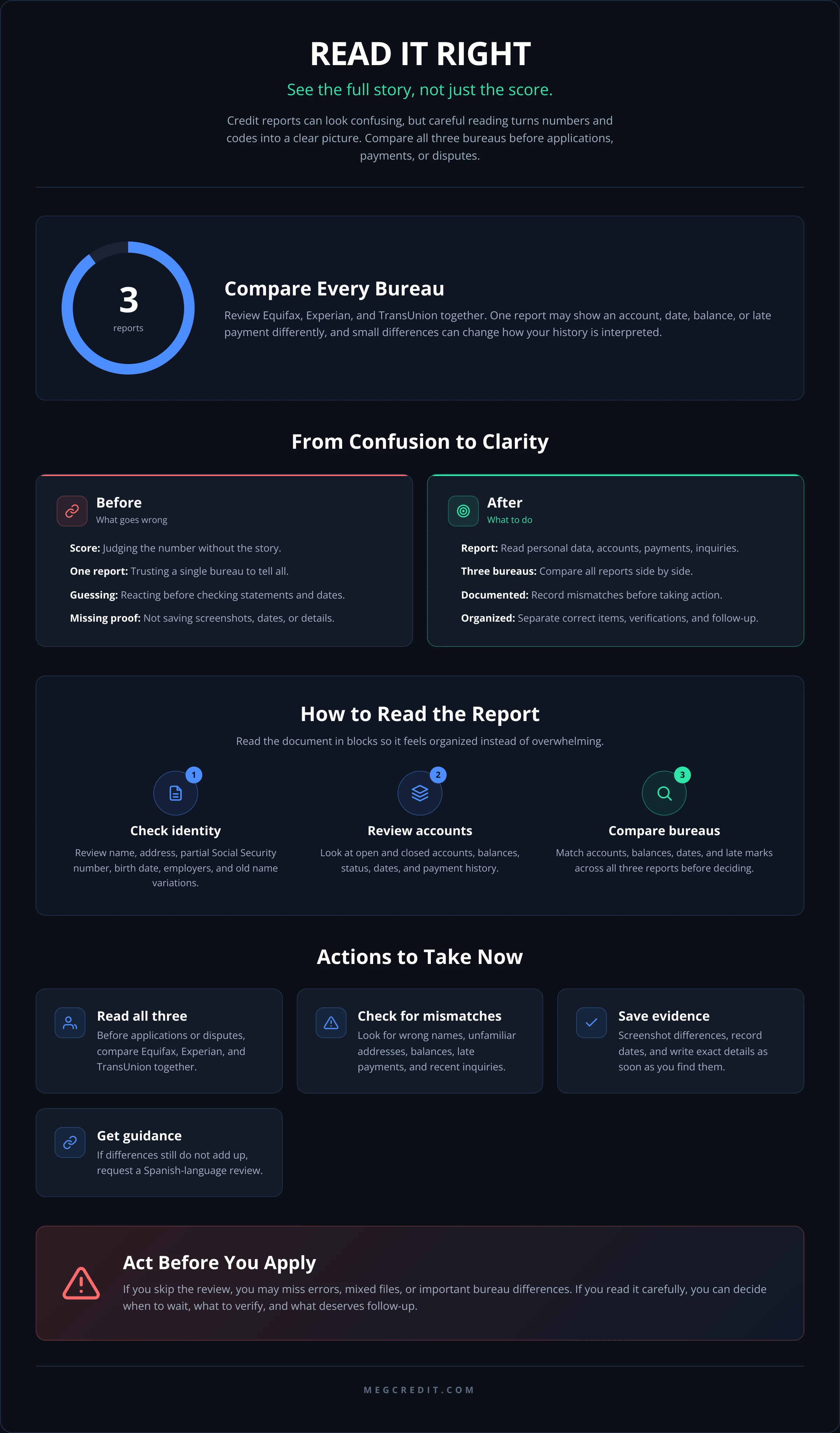
- Review all three reports before making decisions about applications, payments, or disputes.
- Look for personal information, open accounts, balances, late payments, and recent inquiries.
- A small error can change how your history is interpreted, even if it does not affect every bureau the same way.
- Reading it correctly is not just about “checking your score”; it is about understanding the story each report tells.
- If something does not add up, documenting it from the start saves time and prevents confusion later.
Having your credit report in front of you and not knowing where to begin creates tension: you see numbers, codes, and abbreviations, but it is not clear what needs attention and what does not. If you are trying to understand how to read my credit report without getting lost in the details, the first step is to organize the page and read with purpose, not with anxiety.
How to read my credit report without losing the thread
A credit report is not reviewed like an ordinary list. It is read in blocks: first your information, then the accounts, then the payment history, and finally the inquiries and remarks. When the order makes sense, the document stops feeling like a maze.
If you have reports from Equifax, Experian, and TransUnion, do not assume the three show exactly the same thing. One account may appear on one report and not another, or it may show a different date. That is why, when someone asks how to read my credit report, the useful answer is not “look at your score,” but “compare what each bureau is saying about you.”
Start with your personal information
Your name, address, partial Social Security number, date of birth, and employers usually appear at the top. Here you are not looking for cosmetic perfection; you are looking for accuracy. A misspelled name or an address you do not recognize may be just an administrative detail, but it can also signal mixed files.
It is also worth checking whether old name variations appear that you have not used in years. They are not always a problem, but they do give clues about how your information has moved over time. When strange data appears right at the start, everything else deserves extra attention.
Then look at the accounts and their status
Open and closed accounts tell the main part of the story. Notice the account type, opening date, credit limit or original amount, current balance, and whether the status says current, late, in collections, or closed. If an account you do recognize shows a balance you were not expecting, write it down before drawing conclusions.
One important detail: not every account affects the profile’s overall picture in the same way. A credit card with a high balance and on-time recent payments reads differently from an account with several late payments reported. The value of knowing how to read my credit report is precisely in identifying which signal matters most in your situation.
Signs that deserve real attention
Not every “odd” detail deserves an immediate dispute, but it does deserve a more serious review. The common mistake is focusing only on the score and overlooking the information that explains it. A well-read report reveals patterns: repeated late payments, high utilization, unnecessary inquiries, or balances on closed products.
Late payments and dates that do not match
The payment history section is usually the most delicate. A 30-day late mark may not mean the same thing as a pattern of frequent delinquencies, which is why you need to look at the context. If the reported date does not match what you remember, check your statements, emails, or payment records before taking action.
It also helps to see whether one bureau lists an account as late while another shows it as current. That difference is not unusual, but it is meaningful. Once you understand that variation, how to read my credit report stops being a guessing game and becomes a side-by-side review.
High balances and credit use
On credit cards, a high balance relative to the available limit can put more pressure on the profile than a moderate balance. You do not need to obsess over every dollar, but you should notice when an account has been persistently loaded up. If you have several cards near their limits, the report usually reflects utilization that is worth reviewing carefully.
This is not about looking for shortcuts. It is about seeing whether your balances match your real repayment capacity and the kind of use you want to show. To better understand which factors often influence this reading, this article on five factors that can influence your credit score may help.
Recent inquiries and new accounts
Hard inquiries and newly opened accounts say something about financial activity. If you see several applications in a short period, check whether you truly authorized them. Sometimes the issue is not one inquiry, but the combination of several over a brief window.
A recent account opening is not always bad, but it does change the context. If you are organizing how to read my credit report to prepare for a future application, these are the sections that most quickly show whether it makes sense to wait, document, or compare before moving forward.
How to compare the three bureaus without mixing up details
When a person checks only one report, they may think they already understand everything. The problem comes when the data changes on another bureau and they do not know which one to trust. In Orlando, where many people manage tight timelines and financial decisions at the same time, comparing all three reports helps you avoid acting blind.
You do not need to memorize technical terminology. It is enough to look at four things on each bureau: matching accounts, opening dates, current balances, and payments marked late. If an account appears on one report but not the others, or if the date changes, write it down exactly as it appears.
What differences are normal and which are not
It is normal for not everything to appear at the same time on all three reports. A creditor may report at different intervals, and each bureau processes the information through its own system. What you should not ignore is a difference that changes the meaning of the history: a closed account that appears open, a late payment missing from one bureau, or a balance that looks much higher on one report than on another.
When you compare it this way, how to read my credit report becomes a task of contrast, not just observation. And that contrast helps you decide whether you need to verify documents, speak with the creditor, or prepare a more organized review.
What to do if one report shows something the others do not
First, confirm whether the information belongs to you. Second, review the timeline: dates, amounts, and account type. Third, note where each item appears and how it is described. That simple path keeps you from turning a reasonable question into a rushed reaction.
If the information seems incorrect, a three-bureau credit review can help you see the full pattern without mixing everything together. MAGICENTERPRISE GROUP works precisely with that side-by-side reading so the person understands what they are seeing before deciding the next step.
Common mistakes when reviewing your report on your own
Many people check the report with good intentions, but they only scratch the surface. The most common mistake is thinking every “low” or “high” number carries the same weight. Another is assuming that a clean report on one bureau means the other two are the same.
Confusing your score with your report
The score summarizes, but it does not explain. The report shows the story behind that number. If you only look at the score, you can miss the real reason for a change: a high balance, a recent inquiry, a late account, or an unexpected closure.
That is why, when someone wants to understand how to read my credit report, it helps to separate two questions: “What does it say?” and “What is supporting it or dragging it down?” The second one is the one that gives you control.
Looking only for the negative
The opposite also happens: a person goes in expecting trouble and ends up reading everything as a threat. That leads to overreacting. An account managed well, a stable history, or a balanced mix of credit also matter and should be noted.
This is not about ignoring what is wrong. It is about seeing the full picture. A report always has areas that speak to risk and others that show responsible behavior; reading it well means identifying both.
Not saving evidence
If something does not line up, take a screenshot, save the date, and write down the exact detail. It may seem basic, but it prevents confusion when you return to the document weeks later. Without a record, a useful observation can easily be lost.
It also helps to prepare your documents before any deeper review. If you want to get organized ahead of time, this guide on how to prepare for a credit evaluation can serve as practical support.
What to review before making decisions about your credit
Before applying for a card, a loan, or a refinance, it is worth checking whether your report is showing stability or recent movement. That reading changes the strategy. A decision made without looking at the report can cost more in time, effort, or unnecessary denials.
When it makes sense to wait
If you see recent inquiries, high balances, or late accounts on any of the bureaus, it may be better to wait and review the full picture first. Waiting does not always mean “do nothing”; sometimes it means organizing documents, verifying accounts, and understanding what is weighing the most.
At that stage, the right reading keeps you from making impulsive decisions. If you are working on credit education, the report becomes a planning tool, not a source of stress.
When it is worth asking for guidance
If you have already compared the reports and still do not know what a difference means, asking for guidance can save time. A well-done credit review does not promise magic results; it shows where inconsistencies are, which account needs attention, and which decision makes the most sense in your context.
That approach is especially useful when information is spread across several bureaus and you do not want to act on instinct. It also helps if you prefer an explanation in Spanish, with clear steps and no unnecessary jargon.
How to organize yourself after the review
After reading the report, write three simple lists: correct accounts, data you need to verify, and items that require follow-up. That classification reduces confusion and helps you act in an organized way. If everything feels equally important, you are probably mixing different signals.
A credit evaluation and guidance service can help you turn that list into a clearer plan, especially if you want to understand what to do first and what can wait.
Support in Orlando to read your reports with confidence
Not everyone needs the same kind of help. Some people only want to confirm whether a detail is correct; others need to review all three reports more carefully because they found differences they do not know how to interpret. In both cases, the valuable part is having a responsible, educational, and pressure-free reading.
If you live in Orlando and want guidance in Spanish, reviewing all three bureaus with a guided eye can save you from interpretation mistakes. That is the part people often underestimate: reading well also means deciding what not to move yet.
Official information about the reporting system and consumer rights can be found on the Consumer Financial Protection Bureau website, especially if you want to better understand how disputes or data reviews work. And if you need access to the free annual report, AnnualCreditReport.com remains the most useful stable reference to start with.
Frequently asked questions
How often should I check my credit report?
It depends on your situation, but checking it regularly helps you spot changes early. If you are making important financial decisions, looking at all three reports before acting is usually a good habit.
Is it normal for the three bureaus to show different information?
Yes, it can happen. A creditor does not always report at the same pace to all three systems, so it is worth comparing dates, balances, and account statuses on each one.
What should I do if I find an account I do not recognize?
First, check whether it could be a trade name, a previous creditor, or a closed account you forgot about. If it still does not add up, save evidence and review the information carefully before making decisions.
Does reading the report tell me exactly what to do about my credit?
It gives you the foundation to decide better, but it does not replace a full review. Reading it correctly shows you where inconsistencies are, what looks stable, and what deserves follow-up.
Can I ask for help even if I do not understand the technical terms?
Yes. In fact, that is one of the best reasons to ask for guidance. A Spanish-language review can help you interpret each section without assuming you already know what it means.
If you want to review all three reports with someone who can clearly explain what each difference means, contact Magic Enterprise Group and request a review in Spanish. An organized reading today can help you avoid rushed decisions tomorrow.
If you are in Orlando and need to understand your report before taking the next step, schedule your review through Contact.